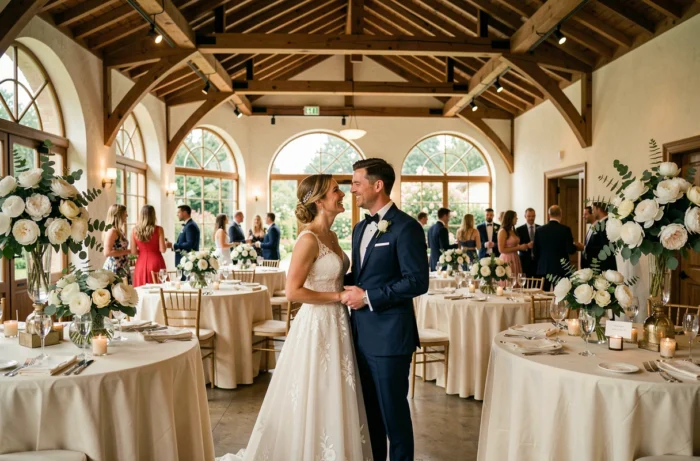
Organizing a perfect wedding relies less on a generic checklist and more on concrete decisions that are often underestimated. We have compiled ten tips that target real friction points, from financing to the logistics of the big day.
1. Declare family gifts using the Cerfa form n°2735
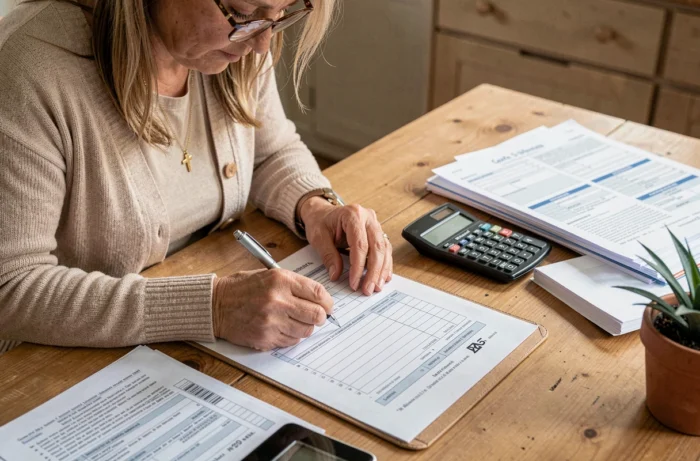
In 2026, the couple will finance between 50 and 70% of the budget from their own savings. Parents now contribute through a lump sum, often between 3,000 and 10,000 euros per family, rather than covering specific expenses.
This change has a direct administrative consequence: any significant gift must be declared using the Cerfa form n°2735. Neglecting this step exposes you to potential tax reassessment, a risk that most planning guides overlook.
We recommend handling this formal step as soon as the funds are received, even before booking the venue. Find wedding advice on Actu Mariage to delve deeper into the budgetary and administrative aspects of your preparation.
2. Secure the reception venue by checking environmental labels

The choice of venue determines the date, the number of guests, the caterer, and the logistics. Signing a reservation contract without verifying certain structural criteria is like building the rest of the organization on sand.
Environmental labels (Green Key, European Ecolabel) are becoming a key selection criterion for couples sensitive to eco-responsible practices. A labeled venue often imposes constraints on waste, noise, or fireworks: it’s better to know this before signing.
Also check the on-site accommodation capacity, the time restrictions imposed by the town hall, and the possibility of bringing your own caterer.
3. Negotiate each service provider contract with a written cancellation clause

No verbal agreement holds weight without a signed written document. Photographer, DJ, florist, caterer: each service must be subject to a detailed quote turned into a contract, explicitly mentioning the cancellation and deposit refund conditions.
We regularly observe disputes related to non-refundable deposits when the couple changes the date or package. Demand a clause specifying the percentage retained based on the cancellation notice period (three months, one month, fifteen days before).
4. Create a dedicated email address and a centralized tracking spreadsheet

A shared email address (like firstname.firstname.wedding@) prevents drowning service provider communications in personal inboxes. Pair it with a structured shared spreadsheet organized into tabs:
- Projected budget and actual expenses, with automatic variance
- List of service providers with follow-up dates and contract status
- Guest list with responses, dietary restrictions, and accommodation
This setup effectively replaces paid applications and remains editable by both partners in real time.
5. Finalize the guest list before choosing the theme or decoration

The number of guests determines the budget, not the other way around. Finalizing a firm headcount (immediate family only, extended circle, colleagues included or not) dictates the size of the venue, the catering volume, and the seating plan.
We recommend locking in this list at least eight months before the ceremony. Last-minute additions lead to cascading extra costs: additional place settings, printing new invitations, rearranging the seating plan.
6. Plan a reverse timeline from the big day

A linear timeline (month by month moving forward) gives the illusion that time is expandable. The reverse timeline starts from the wedding date and works backward: it forces you to identify non-negotiable deadlines.
- Publication of the banns at the town hall: at least ten days before the civil ceremony
- Final fitting of the wedding dress: four to six weeks prior
- Final confirmation of the number of place settings with the caterer: often two weeks prior
Each service provider has its own confirmation deadlines. Noting them in the centralized spreadsheet helps avoid forgetfulness.
7. Allow a budget margin for unforeseen expenses

Almost all couples report exceeding their initial budget. The main reason is not a lack of discipline, but the absence of a budget line explicitly reserved for unforeseen expenses.
Setting aside a contingency fund from the start (about one-tenth of the total budget) absorbs extra costs without destabilizing priority items. Renting additional heating in case of bad weather, replacing a failing service provider, adding a shuttle for guests: these unplanned expenses always arise.
8. Optimize group photos with a written shot list
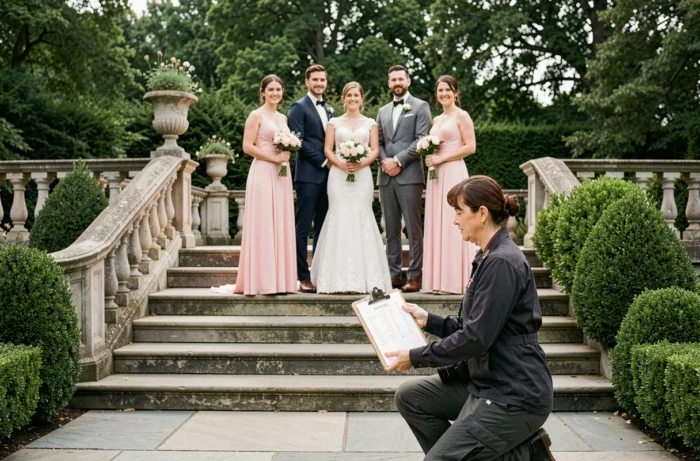
The photographer does not know your family. Without a written list of desired combinations (couple alone, extended family on the groom’s side, childhood friends, siblings), group photos can eat into cocktail timing.
Draft this list in advance, share it with the photographer, and designate a point person to gather the groups. A structured shot list cuts this sequence in half.
9. Assign a day coordinator separate from the couple
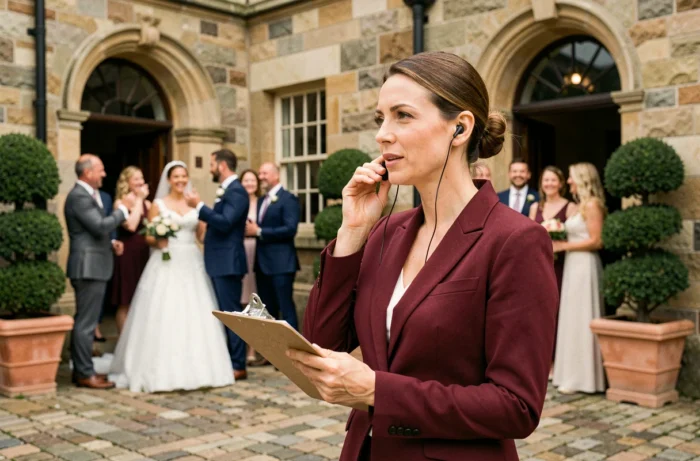
On the big day, the couple cannot manage logistics. Entrusting the schedule to an organized friend or a professional wedding planner prevents cascading delays.
This coordinator holds the minute-by-minute schedule, the contact numbers for all service providers, and the keys to the venue. They manage the transition between cocktail and reception, initiate activities, and resolve technical issues without involving the couple.
10. Test the catering menu in real conditions before approval

The tasting at the caterer remains the only reliable way to validate the choice of reception meal. Taste the dishes in the order of service, with the same quantities per plate as on the big day.
Use this session to check the management of dietary restrictions (vegetarian, gluten-free, allergies). A caterer unable to offer convincing alternatives during the tasting will not perform better in front of a hundred guests. The tasting is an operational test, not a commercial formality.
These ten points do not cover everything, but they target areas where mistakes are most costly, both in time and budget. Each decision made early alleviates mental load, allowing you to truly enjoy the day.