
A child fidgeting in their chair, a car ride that drags on, a rainy afternoon with no plans: we all know that moment when we need to find a screen-free activity, immediately, with what we have on hand. A piece of paper and a pen are enough, as long as you know what to do with them beyond simple free doodling.
Pencil and paper games for a child who loses interest quickly: capturing attention differently
Most lists of pencil and paper games assume that the child will sit down, listen to the rules, and play calmly. In practice, a five or six-year-old who refuses calm activities is not going to be excited about a classic tic-tac-toe after the third game.
What changes the game is the short constraint. We set a tight framework: draw a monster in under thirty seconds, invent a word that doesn’t exist and give it a definition, fill a square of four boxes with four different emotions. The time constraint turns the game into a challenge, and the challenge captures attention where total freedom scatters it.
As highlighted by Le Chaudron Des Jeux’ advice, these simple games with a piece of paper and a pen work on children’s creativity well beyond mere entertainment. We are talking about cognitive learning support, not just a pastime to fill a gap.
Another concrete lever: adult participation at the same level as the child. We draw together, we show our failed drawings, we laugh at the results. A child who sees a parent joyfully fail to draw a horse in ten seconds enters the game much more easily than a child who is handed a blank sheet and told, “Here, draw something.”
Transforming a blank sheet into a guided creativity tool

The blank sheet is intimidating. Even adults know this paralysis. For a child, the problem is even more pronounced: too many choices kill the choice. Guided creativity consists of narrowing down the possibilities to free the imagination within a framework.
Three formats work particularly well depending on the child’s age and temperament:
- The drawing to complete: we draw a random shape (a zigzag, a circle, three dots) and the child must transform it into something recognizable. Each shape becomes an animal, a vehicle, a character, without the pressure of “drawing well.”
- The folded mini-book: an A4 sheet folded into eight creates a four-page booklet. The child invents a character, a problem, and an ending. The short format prevents discouragement because the book is “finished” in just a few minutes.
- The directed exquisite corpse: instead of the classic format where everyone draws blindly, we impose a thematic constraint (only robots, only sea animals). The result is more coherent, and the child can tell a story based on the final drawing.
These approaches fit into a broader trend where screen-free activities oriented towards creation are formulated as complete alternatives to digital leisure, not as a consolation prize while waiting to get the tablet back.
Drawing and writing activities: adapting the game to age without infantilizing
We often make the mistake of offering the same game to a four-year-old and a nine-year-old. Tic-tac-toe works at any age, but it does not activate the same skills. To truly stimulate imagination and creativity, the complexity level of the game must match what the child already knows how to do, with an extra notch of difficulty.
Between four and six years old, drawing is the main channel. Tracing games (connecting dots to form a surprise drawing, coloring only the boxes containing a specific letter) combine fine motor skills and discovery. We stick to minimal materials: a sheet, a pen, possibly two or three colors.
From seven or eight years old, writing comes into play. A child who can write can invent rebuses, create a secret code with a drawn alphabet, or write riddles for other players. The transition from drawing alone to a mix of drawing and writing opens up a much broader field of games.
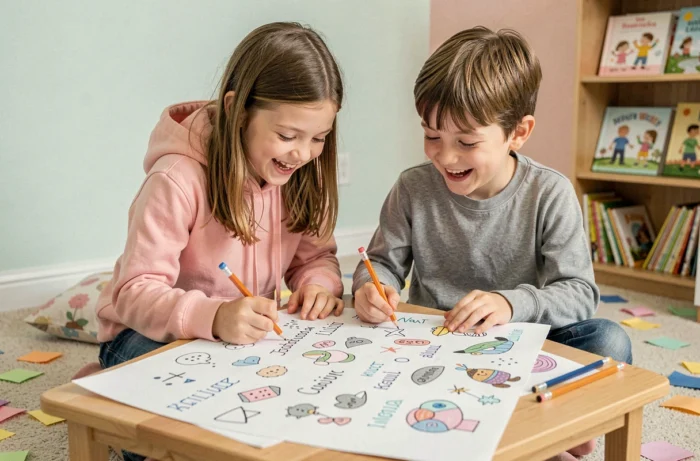
For older children (ten years and up), creating game rules becomes the game itself. We invite the child to invent a board game that can only be played with paper and a pencil, write the rules, test it, and then modify it. This process engages logic, writing, and creative thinking simultaneously.
Managing the transition from screen to paper: the moment that changes everything
The real friction point is not the lack of ideas. It’s the transition from screen to paper. A child used to the rapid stimulation of an app will find the blank sheet boring for the first two minutes. Feedback varies on this point, but one constant remains: the transition happens in the very first seconds.
In practical terms, we don’t say “we’re going to draw” (too vague, too school-like). We ask a specific question: “Do you think you can draw a scary dragon in under twenty seconds?” The timer and the challenge short-circuit the initial resistance.
The goal is not to replace screens, but to create an alternative ritual. A five-minute pencil-and-paper game before dinner, a drawing challenge notebook in the bag for trips, an exquisite corpse on Sunday morning. Regularity creates habit, and habit eliminates negotiation.
What distinguishes this approach from a simple list of ideas is that it places the sheet and pen within a framework of active participation. The child is not a passive recipient of an activity proposed by the adult: they co-construct, modify the rules, propose variations. It is in this decision-making space that creativity truly develops, much more than in executing a closed instruction.
Keeping a small notebook dedicated to pencil-and-paper games, tucked in the backpack or on the living room table, is enough to make these activities accessible at any time. No need for elaborate artistic materials or preparation: a sheet, a pen, and a well-chosen constraint do the rest.