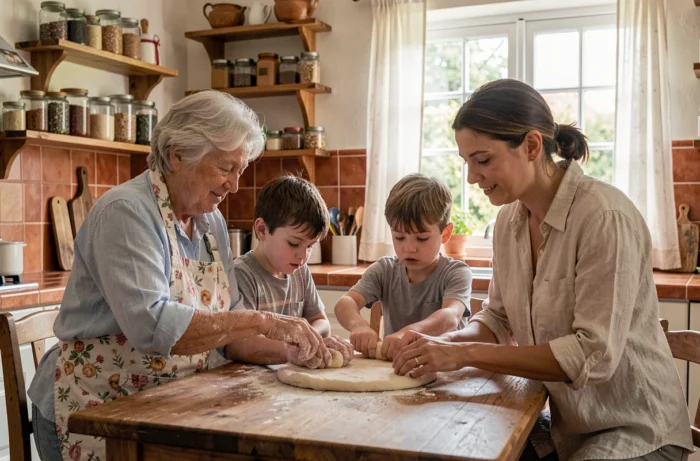
Physical co-presence does not automatically create family bonds. Recent analyses of hybrid work organization show that increased presence at home does not automatically lead to more harmonious relationships between partners or with children. Strengthening family ties on a daily basis requires active mechanisms, not just spatial proximity.
Hybrid Telework and Family Bonds: The Trap of Perceived Availability
Hybrid organization, which has become the dominant form of remote work in France, significantly alters domestic daily life: staggered meals, noise, shared use of rooms, frequent interruptions. We observe that this reconfiguration creates an illusion of shared time.
The parent is physically present but cognitively absorbed. The child perceives a availability that does not actually exist, leading to frustration on both sides. The partner may interpret this presence as an opportunity to delegate household tasks, while the professional mental load remains intact.
Research published in Frontiers in Psychology confirms that telework often improves parent-child time, but puts the couple’s relationship to the test. Women continue to bear more domestic work on average, which limits the expected positive effect. Several online resources document these family dynamics, and the website www.buzzstream.fr notably lists concrete approaches to structuring family life around these new constraints.
We recommend explicitly segmenting availability time slots: a closed work slot (door closed, no interruptions) is better than a half-day of false accessibility. The quality of the bond depends on the clarity of boundaries, not their absence.

Structured Family Rituals: Frequency and Predictability Over Duration
An effective family ritual relies on two parameters: its regularity and predictability. Duration is secondary. A ten-minute exchange every evening at a fixed time produces more cohesion than a three-hour monthly outing because the brain associates repetition with relational security.
Criteria for a Long-Lasting Ritual
- An automatic trigger linked to an existing moment (end of a meal, school run, return from work) rather than an added time slot in the schedule
- Participation without performance obligation: the ritual should not become an evaluated activity (no competitive games, no disguised school assessments)
- Role alternation so that each member initiates the ritual in turn, distributing the organizational load often carried by one parent
The most robust ritual is the one that survives a bad day. If it requires preparation, materials, or good humor, it will be abandoned within weeks. A simple roundtable where everyone shares a significant event from their day, without commentary or judgment, fulfills this function.
Family Communication: Active Listening and Emotional Regulation
Family communication rarely fails due to a lack of words. It fails due to excessive emotional reactivity. When a teenager expresses frustration, the typical parental response (immediate advice, minimization, reminder of rules) cuts off the relational channel before it can open.
Active listening in a family context requires suspending the educational posture. Listening does not mean validating, but acknowledging receipt. Reformulating (“you’re telling me that you found the day difficult”) produces a recognition effect that advice (“you should organize yourself better”) does not.
Adapting the Register According to the Child’s Age
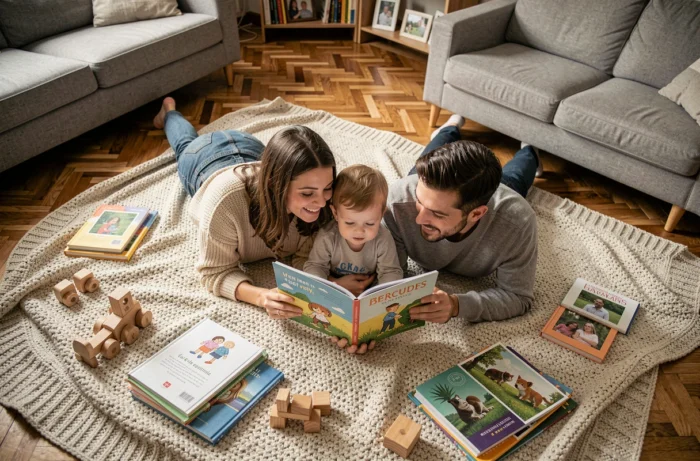
With children under six, the verbal channel remains limited. The bond comes through parallel play (playing alongside the child in the same activity without directing) and physical contact. With pre-teens, conversation moments arise in the interstices: car rides, meal preparation, walks. Forcing a face-to-face often leads to a blockage.
With teenagers, we recommend favoring asynchronous exchanges when the topic is sensitive. A written message allows time to formulate without the pressure of immediacy. The bond is not built solely in spontaneous oral communication.
Distribution of Household Tasks and Sense of Family Equity
The family bond silently deteriorates when a member perceives an injustice in the distribution of tasks. This mechanism affects both the couple’s relationship and the parent-child relationship. Perceived equity matters more than actual equity: an accepted imbalance does not produce resentment, while a suffered imbalance does.
Available data shows that women continue to bear the majority of household work, even in households where both parents are teleworking. This asymmetry directly affects the relational quality of the couple and, by extension, the overall family atmosphere.
- Make tasks visible: a shared board (paper or digital) listing the tasks completed by each neutralizes the bias of underestimating others’ work
- Involve children as soon as possible in age-appropriate responsibilities, not as a chore but as a contribution to collective functioning
- Reassess the distribution periodically, as professional constraints and needs evolve
A household where everyone feels like an active contributor functions like a team. The family bond relies on a sense of belonging, and belonging comes through contribution. Families that formalize this distribution, even in a simple way, report fewer conflicts related to daily domestic life.
Strengthening family ties requires neither budget nor exceptional activities. The regularity of rituals, the clarity of boundaries between actual availability and physical presence, and an equitable distribution of domestic responsibilities constitute the three most sustainable levers. The bond is built through the repetition of sincere micro-interactions, not through grand occasional gestures.