
A group of twelve friends, three cars, a free weekend, and a groom-to-be who has no idea what’s coming. At this stage, most organizers rush into planning activities. Mistake: it’s the logistics beforehand that make the difference between a memorable bachelor party and an embarrassing fiasco.
Collective bachelor party budget: the rule that avoids tensions
We’ve all experienced that moment when, after the party, someone pulls out a spreadsheet and discovers that half the group hasn’t paid their share. To avoid this, we set the overall budget before choosing any activities. We collect the money in advance via an online pot, not afterwards.
The groom-to-be does not pay; that’s the basic convention. His budget is divided among all participants. In practice, we divide the total by the number of confirmed guests, not by the number of “maybes.” Only those who have confirmed and paid their share count in the calculation.
Those who have already followed the 11 commandments for a perfect bachelor party know this: the budget dictates everything else, from the choice of destination to the level of comfort of accommodation.
Think of the bachelor party as a series of atmospheres, not a single block
The classic format (restaurant followed by nightclub) is losing its appeal. Groups that come back with the best memories have structured their day like a road trip of successive experiences. We move from a physical outdoor activity to a quieter moment, then to a festive evening.
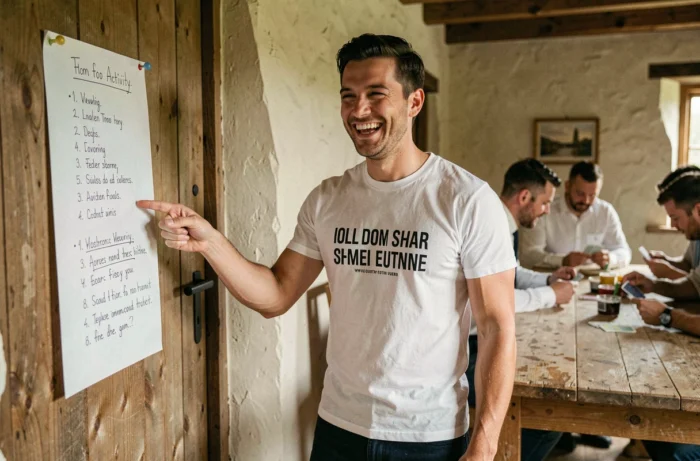
In practical terms, this results in three distinct sequences throughout the day:
- An adrenaline or competitive activity in the morning (go-karting, paintball, canyoning), when the group’s energy is at its peak
- A recovery time in the afternoon, such as a private spa, hammam, or Nordic bath, so everyone can catch their breath before the next part
- An evening with a strong identity (cocktail bar, dinner in an unusual venue, nighttime escape game) rather than a default nightclub outing
Planning a recovery sequence between two high-energy moments radically changes the atmosphere. The group stays united until the end instead of losing half the participants by 11 PM.
Guest list and secret communication for a surprise bachelor party
The question of surprise divides opinions. Some grooms-to-be hate not being in control, while others love discovering the program throughout the day. We settle this point right from the start with the main witness.
If we opt for a total surprise, we create a discussion group without the groom-to-be and designate a single contact person to manage practical information (location, timing, dress code). Multiplying sources of information increases the risk of leaks.
For the guest list, we consult the groom (or his/her partner) indirectly. Inviting a colleague he barely tolerates or forgetting his childhood best friend can ruin the day. We aim for a group of eight to fifteen people: enough to create a dynamic, but not too many to remain manageable in terms of booking and transportation.
Original bachelor party activities: avoiding humiliating challenges
We’re moving away from ridiculous costume challenges in the street. The current trend leans towards activities that reflect the groom’s personality. A cooking enthusiast will be more impressed by a knife-making workshop than by a bar crawl dressed as a banana.

The program is built around the groom’s tastes, not clichés. We discreetly ask his close ones to identify what would truly please him. An adrenaline junkie will want bungee jumping. A food lover will prefer a blind tasting.
Feedback varies on this point, but groups that mix a collective physical activity with a more intimate moment (dinner prepared together, screening of nostalgic videos) seem to have better memories than those that just chain alcohol-fueled challenges.
Alcohol regulations and safety during an outdoor bachelor party
Organizing a bar or serving alcohol in a public place is not something to improvise. If the group plans to consume outdoors (park, beach, open private land), certain rules apply. The sale of spirits (whiskey, rum, vodka) is prohibited without the appropriate license, with fines reaching up to 3,750 euros for violations.
In sports venues, the regulations are even stricter. If the bachelor party includes an activity in a stadium or gym, alcohol on-site is off-limits.
For transportation, we designate one or two designated drivers (sober drivers) in the morning, or we arrange for a minibus with a driver. This is an expense that should be included in the initial budget rather than cobbled together at the last minute.
Timing and logistics: setting the date at the right time
We organize the bachelor party two to three months before the wedding. Too early, and the group isn’t in the mood yet. Too late, and the stress of the wedding makes the groom less available, and a logistical hiccup won’t have time to be resolved.
Sending invitations at least six weeks before the chosen date helps secure attendance and finalize bookings. We choose a weekend without a public holiday or major sporting event to increase everyone’s availability.
For accommodation, the Le Meur law of November 2024 has changed the rules applicable to tourist rentals. In practice, this means we check that the chosen rental is properly registered, especially in large cities where inspections are tightening. A non-compliant rental canceled at the last minute means rethinking the entire weekend.
A successful bachelor party rarely hinges on spectacular activities. It relies on a clear budget from the start, a well-calibrated group, a rhythm that alternates intensity and relaxation, and an organizer who has wrapped up logistics early enough to enjoy the party too.