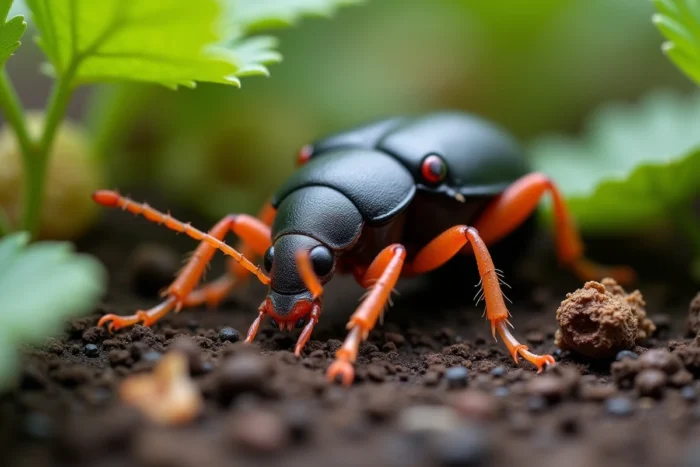
Pseudoophonus rufipes (synonyms: Harpalus rufipes, Ophonus pubescens) is a granivorous carabid beetle from the Harpalinae family. The adult measures about 15 mm, displays a brownish-black hue with pubescent elytra reflecting golden tones and distinctly hairy tarsi. On strawberries, it tears off the achenes and cuts into the fruit’s epidermis, causing rapid rot. In gardens as well as indoors, managing this species requires a targeted approach.
LED Lighting on Facades and Nocturnal Intrusions of Pseudoophonus rufipes
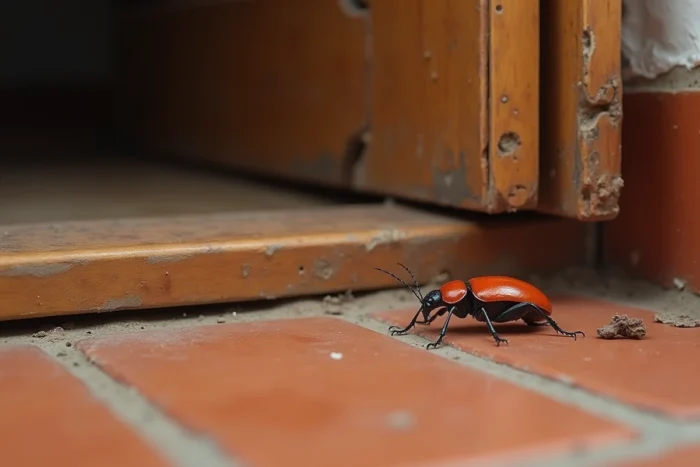
The red-legged ophone is strongly phototropic. Field reports from pest control professionals have noted an increase in intrusions in homes equipped with powerful LED spotlights on facades in recent years. Adults concentrate under these light sources and then enter through gaps around door frames, poorly fitted door thresholds, or low ventilation grilles.
We recommend primarily reducing or eliminating cold white outdoor lighting after nightfall, especially from late spring to autumn, which is the peak activity period for adults. Replacing cold white LEDs with amber or yellow narrow-spectrum LEDs significantly decreases attraction. Sealing gaps around joinery with brush seals or door sweeps completes the physical barrier.
To combat pseudoophonus rufipes in the home, this reduction in light attractiveness remains the most effective measure before resorting to chemical or biological treatments.
Crop Damage: Strawberries, Seedlings, and Weeds
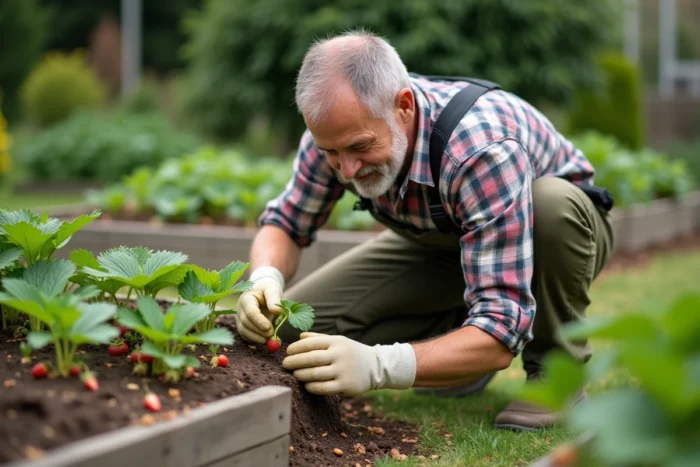
Pseudoophonus rufipes is primarily a granivorous insect. INRAE, through its Ephytia database, classifies it among the pests of strawberries: the adult tears off the achenes and can cut into the fruit’s epidermis, paving the way for secondary rots. Everbearing strawberries, which fruit over a long period, are particularly exposed.
The ophone is not limited to strawberries. It consumes the seeds of many cultivated and forest plants (pine, oak, birch), as well as weed seeds. This last point is notable: in large-scale farming systems, the species plays a role as a predator of weed seeds, placing it in a gray area between beneficial and pest depending on the context.
Vegetable Garden and Direct Sowing
In the vegetable garden, direct sowing of leafy vegetables and legumes is vulnerable. The larvae, with short and poorly sclerotized bodies, remain in the soil and feed on organic matter without causing major foliar damage. It is the adults that pose a problem on the surface, mainly at night.
Trapping using buried pots (Barber traps) filled with a base of beer or vinegar allows for assessing population density before deciding on an intervention. If captures remain low, tolerance is often the best option.
Reasoned Control of the Strawberry Beetle in the Garden
Carabids are generally classified as beneficial auxiliaries in agriculture by European plant protection services. This classification pushes official recommendations towards reasoned control rather than systematic eradication, including for Pseudoophonus rufipes. Mass destruction of carabids in a garden amounts to removing predators of slugs and larvae of harmful insects.
We therefore favor a three-tiered strategy:
- Physical barriers around strawberry plants: insect netting laid on the ground in the evening, removed in the morning to allow pollination. This method protects the fruits without affecting other carabids present in the garden.
- Habitat management: removing piles of stones and dead wood in the immediate vicinity of sensitive crops while retaining them at the edge of the plot to maintain functional biodiversity.
- Targeted interception traps (Barber pots, refuge boards turned over each morning) to capture and relocate adults away from crops, without resorting to broad-spectrum insecticides.
Pseudoophonus rufipes in the House: Distinguishing the Ophone from the Cockroach
Confusion with cockroaches is common. The red-legged ophone shares a vaguely similar size and hue with the German cockroach, triggering unjustified alerts. A few criteria allow for quick differentiation:
- The elytra of P. rufipes are pubescent, with a characteristic golden sheen. A cockroach has smooth and shiny elytra.
- The tops of the ophone’s tarsi are distinctly hairy, a criterion visible with a magnifying glass or in a macro photo. Cockroaches have glabrous tarsi.
- The ophone is stocky, with a wide pronotum. The cockroach is flattened dorsoventrally, adapted to slip into narrow cracks.
- An ophone found indoors is almost always a solitary individual attracted by light. A cockroach usually indicates an established colony.
If identification confirms P. rufipes, no indoor insecticide treatment is necessary. The captured individual can be released in the garden. The priority remains to correct the light attraction factor described above.
Insecticides and Natural Alternatives: What Really Works
The use of broad-spectrum chemical insecticides against a solitary carabid in a vegetable garden or home is disproportionate. It destroys populations of beneficials (other carabids, rove beetles) that regulate slugs and aphids.
Diatomaceous earth applied in a thin layer along door thresholds and baseboards constitutes an effective mechanical barrier against indoor intrusions. Outdoors, sprays of fern manure or applications of entomopathogenic nematodes target larvae in the soil without affecting surface beneficial fauna.
For heavily infested strawberry crops, some professionals resort to granulated baits based on iron phosphate (initially designed against slugs), which also reduce populations of nocturnal granivores. We observe that this approach yields better results than foliar treatments, as the ophone feeds on the ground.
Managing Pseudoophonus rufipes relies on a simple triptych: reduce light attractiveness to protect the home, place physical barriers around sensitive crops, and accept the residual presence of an insect that, in the majority of gardens, consumes more weed seeds than strawberries.