Child development refers to the set of motor, cognitive, language, and socio-emotional skills that are built from birth until the start of school. These acquisitions do not follow a rigid schedule: each child progresses at their own pace, but certain environmental conditions can measurably enhance or hinder this process.
Domestic background noise and attentional regulation in young children
A parameter rarely mentioned in parenting guides concerns the sound load of the household. Television constantly on, phone notifications, electronic toys that emit sounds on loop: this sound backdrop is not neutral for a developing brain.
Several recent studies associate regular exposure to a very noisy home environment with difficulties in attentional regulation and increased restlessness in toddlers. The mechanism is logical: a child who must constantly sort through auditory stimuli dedicates part of their cognitive resources to filtering out noise instead of focusing on an activity, a verbal exchange, or play.
Reducing this load does not mean imposing silence. A few adjustments are sufficient:
- Turn off the television when no one is actively watching it, including during meals and free playtime.
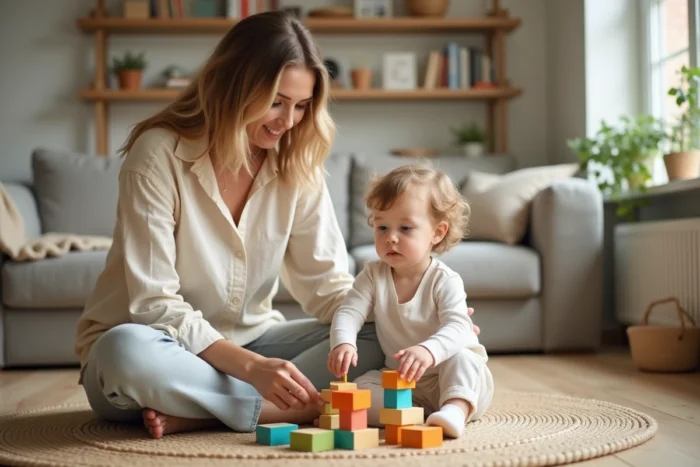
- Favor toys that make sound only when the child interacts with them (a xylophone, blocks) rather than those that play automatic melodies.
- Reserve phone sound notifications for calls, and keep the rest on silent mode during interaction times with the child.
Additional information on the awakening and needs of young children is available on the Vive Mon Bébé website, which details developmental milestones by age group.
Screens before three years: going beyond the “zero screen” rule
The general recommendation remains clear: limit screen exposure as much as possible before three years old. SERP content repeats this message without nuance, but recent French and international recommendations provide useful clarifications on the context of use.

The determining factor is not just the duration, but the type of content and the presence of an adult. A passive screen (a cartoon watched alone while the parent cooks) does not have the same effect as a video call with a grandparent, where the child interacts, points, and answers questions.
Parental co-presence transforms the screen experience into social interaction. Naming what the child sees, asking questions, commenting on images: these simple gestures reintroduce the linguistic and relational dimension that the screen alone suppresses.
This does not justify placing a two-year-old in front of a tablet daily. The idea is rather to distinguish between very occasional use accompanied by prolonged passive exposure, as the two do not produce the same effects on language and attention.
Early detection of developmental disorders: key appointments
Systematic consultations for infants and young children (at nine months, eighteen months, twenty-four months) have evolved in recent years in several French-speaking countries. Updated public health recommendations between 2023 and 2025 now require these appointments to include standardized questions about communication, symbolic play, eye contact, and motor skills.
The goal is to identify developmental delays earlier and quickly refer to intervention services. A child who does not point at eighteen months or who does not combine two words at twenty-four months does not necessarily have a disorder, but these signals warrant further evaluation.
What parents can observe between consultations
Medical follow-up does not cover everything. Between appointments, some simple milestones help to gauge the child’s development without falling into anxiety:
- Around nine months: the child responds to their name, babbles with varied syllables, looks for an object hidden under a cloth.
- Around eighteen months: they point to show something, imitate daily gestures (talking on the phone, sweeping), pronounce a few isolated words.
- Around twenty-four months: they combine two words (“more cake”), show interest in other children, start pretend play (feeding a doll, driving a car).
A delay in just one milestone is not a diagnosis. It is the combination of several persistent signals that should alert and motivate an early consultation.
Child language: the role of “parentese” and verbal routines
Parentese refers to this spontaneous way of speaking to babies with exaggerated intonation, a slower pace, and short sentences. Far from being a useless reflex, it facilitates word segmentation for the infant and captures their auditory attention.

Daily routines (dressing, bathing, meals, walks) provide natural opportunities for language learning. Naming clothes while putting them on, describing foods on the plate, commenting on what is seen while walking: these repetitive exchanges anchor vocabulary in concrete contexts.
Language enrichment also comes through shared reading. Reading a short story before naptime or bedtime, even to a child who does not yet speak, exposes them to sentence structures and vocabulary they would not hear in everyday conversation. Regularity matters more than duration: five minutes each day have a greater effect than a long occasional session.
Child development plays out in the details of daily life, not in sophisticated programs. Reducing ambient noise, accompanying a rare screen moment with dialogue, staying attentive to developmental milestones between medical consultations, and talking abundantly during routines: these simple gestures form the foundation of solid awakening, well before any structured activity.