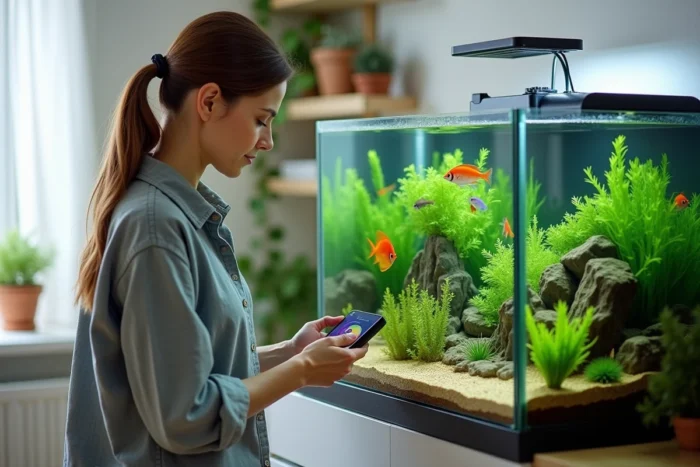
A stable aquarium relies on maintaining precise physico-chemical parameters: pH, nitrites, nitrates, carbonate hardness, temperature. Any prolonged deviation weakens the fish, plants, and the biological balance of the tank. Aquarium management tools have long consisted of paper notebooks and weekly manual tests, but a new generation of applications and connected devices is transforming this routine into a nearly automated monitoring process.
Digital logbooks for aquariums: beyond simple note-taking
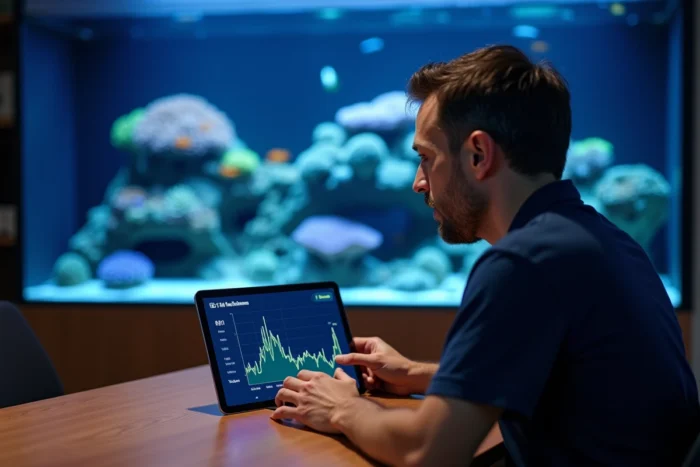
Aquarium tracking applications like Aqualize or AquaDiary do not just replace a wet notebook placed in the tank’s cabinet. They structure maintenance data into readable graphs: pH evolution over several weeks, frequency of water changes, population history.
The interest lies in trend detection. A pH that slowly drifts over three weeks goes unnoticed by the naked eye, but a graph makes it obvious. Some applications also allow users to record installed equipment (filtration, lighting, heating) and schedule maintenance reminders.
For those managing multiple tanks, the My Fish Book homepage gathers useful resources on organization and tracking in aquaristics.
Aqualize even proposes the future import of ICP measurements (spectrometry analysis), which would pave the way for precise monitoring of trace elements without manual entry. This type of feature marks the boundary between a digital notebook and a true technical dashboard.
Connected controllers and aquarium automation: what really changes
Aquarium controllers (Apex from Neptune Systems, Hydros, GHL) have been around for several years, but their use has long been limited to high-end reef aquariums. Their principle: centralize the control of all equipment (pumps, lighting, heating, dosers) from a single interface, often accessible via smartphone.
What has changed recently is accessibility. More compact and less expensive models allow freshwater aquarists to enjoy functions previously reserved for reef tanks:
- Programming lighting cycles with dawn and dusk simulation, which reduces fish stress and promotes plant photosynthesis
- Temperature and pH probes connected to real-time alerts on the phone, with automatic activation of heating or a surface fan
- Peristaltic dosers that inject fertilizers or trace elements at programmed intervals, eliminating forgetfulness and overdosing
Automation does not replace direct observation of the tank. A controller does not detect a budding disease on a fish, nor a filamentous algae that is settling in. The tool streamlines repetitive tasks, but the aquarist’s eye remains the primary probe.
Artificial intelligence and aquarium diagnostics: the first public assistants
The most significant evolution in recent months comes from platforms like ReefMind.ai, which apply an artificial intelligence analysis layer to aquarium data. ReefMind.ai connects to existing controllers (Apex, Hydros) and utilizes measurement histories to interpret ICP results and generate concrete recommendations: adjusting filtration, modifying water flow, correcting feeding.
This type of tool goes beyond a logbook. Instead of simply displaying a nitrate value, it puts it in context with the tank volume, population, type of filtration, and recent history. The resulting diagnosis resembles the advice of an experienced aquarist rather than a simple threshold alert.
Transfer of aquaculture technologies to home aquaristics
This trend is part of a broader movement. In professional aquaculture, platforms like AquaManager or Innovasea monitor dissolved oxygen, temperature, and other critical parameters in production ponds in real-time. The algorithms developed for these professional environments are beginning to be adapted for more modest volumes.
For the home aquarist, the promise is to shift from a reactive mode (a fish is sick, we look for the cause) to a preventive mode (the system signals a drift before it produces visible symptoms).
Choosing your aquarium management tools: technical criteria to check
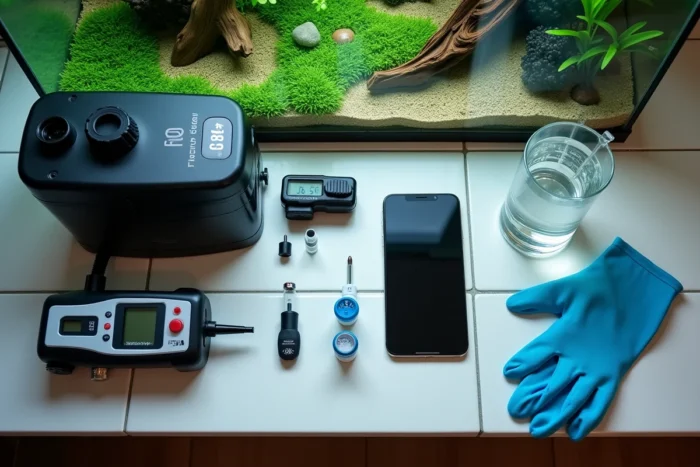
With the proliferation of applications and controllers, the choice depends on the type of tank and the desired level of involvement. A few criteria can effectively sort options.
- Hardware compatibility: a tracking application is only useful if it interfaces with the probes or controllers already in place. Check the supported protocols (Wi-Fi, Bluetooth, open API) before any purchase
- Update frequency: aquarium management software abandoned by its developer quickly becomes obsolete. Actively maintained applications integrate new tests, new species, and fix compatibility bugs
- Data visualization quality: being able to overlay the pH curve and the nitrate curve on the same graph helps identify correlations that would otherwise be invisible
- Multi-tank management: for aquarists maintaining multiple aquariums, the ability to switch from one tank to another within the same interface prevents tracking errors
A poorly chosen tool adds complexity instead of removing it. It is better to have a simple application well used than a sophisticated controller poorly configured.
Managing an aquarium remains an activity of observation and adjustment. Digital tools, from logbooks to AI-powered assistants, do not change this reality. They shorten the time between detecting a problem and correcting it, which directly benefits water quality and the well-being of the species maintained.