
The most shared cooking tips online revolve around batch cooking, plating, or shopping lists. These approaches have their usefulness, but they overlook two recent changes that are significantly altering the way meals are prepared daily: the massive arrival of air fryers in French households and the rise of a kitchen focused on metabolic health, aimed against ultra-processed products.
Air fryer and everyday cooking: what the numbers reveal
A study by IFOP for Pyrex published in August 2026 indicates that 45% of respondents own an air fryer. Even more striking: 56% of owners purchased it in the last 12 months, which reflects a very rapid adoption, well beyond a mere trend.
Eight out of ten users report that the device has changed their cooking habits. More than 80% use it at least once a week. The most cited benefits are time savings (54%), simplification of daily life (34%), the ability to cook healthier (31%), and energy savings (27%).
In practical terms, the air fryer reshuffles the cards of classic cooking tips. Preparations that required a preheated oven for twenty minutes (gratin, roasted vegetables, small cakes) can be completed in a fraction of the time, with less fat. To find more tips on La Cigale et la Fourchette, recipes are categorized by cooking type, making the transition to this preparation method easier.
What the air fryer does not replace
The device excels at dry cooking and small portions. However, stews, broths, and long low-temperature cooking remain the domain of the pot or traditional oven. A lesser-known tip: stacking the racks to cook a vegetable side dish at the same time as a protein, provided that cooking times are compatible.
Field feedback varies on the actual capacity of compact models to feed more than two people. For a family, a model of at least five liters seems to be a functional minimum.
Anti-ultra-processed tips: cooking differently without spending hours
The second change concerns the very content of the plate. For the past two years, research on anti-inflammatory and anti-ultra-processed cooking has significantly progressed. The reflex is no longer just to save time, but to understand what goes into the pan.
The principle is simple: replace industrial sauces, additive-laden bouillon cubes, and ready-made spice mixes with homemade alternatives that are quick to prepare and can be stored for several days.
- A concentrated vegetable broth, prepared in large quantities and frozen in portions in an ice cube tray, replaces the industrial cube in less than ten seconds when cooking.
- A homemade tomato sauce (canned tomatoes, garlic, olive oil, salt) can be prepared in fifteen minutes and covers three to four meals of the week.
- A personal spice mix (cumin, smoked paprika, ground coriander, pepper) avoids commercial preparations that often contain added sugar or dextrose.
These actions do not require any particular technical skills. Their effectiveness relies on the occasional preparation of reusable bases rather than a rigid meal prep organization.
Salt, acidity, fat: the three levers that home cooking underutilizes
Online competitors often list these ingredients as “chef tricks.” The topic deserves to be addressed differently, from the perspective of dosage and timing of addition.
Salting in stages
Salting only at the end of cooking is a common yet limiting habit. Salting at each stage of cooking alters the texture and depth of the dish. A pinch of salt when sweating onions accelerates their caramelization. Another pinch in the pasta cooking water seasons the starch itself. The final salt adjusts the overall flavor.
The result is not a saltier dish, but one where the flavor is better distributed.
Acidity as a last-minute corrector
A drizzle of lemon juice or a spoonful of vinegar added at the very end of cooking acts as a natural flavor enhancer. This action works on soups, stews, tomato sauces, and even legume dishes. Acidity does not change the perceived taste of the dish but enhances each component.
Fat: the role of cold butter at the end of cooking
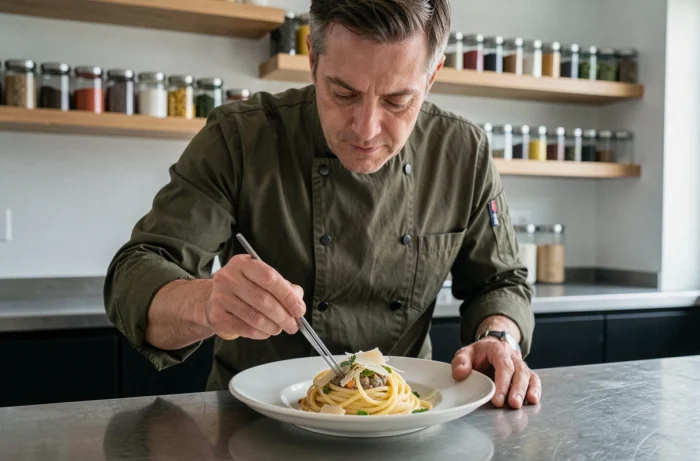
Adding a knob of cold butter to a hot sauce, off the heat, creates an emulsion that adds shine and roundness. This technique (called “monter au beurre”) is used daily in restaurants. It also works with a drizzle of quality olive oil for vegetarian dishes.
Seasonal products and weeknight meals: a direct link to flavor
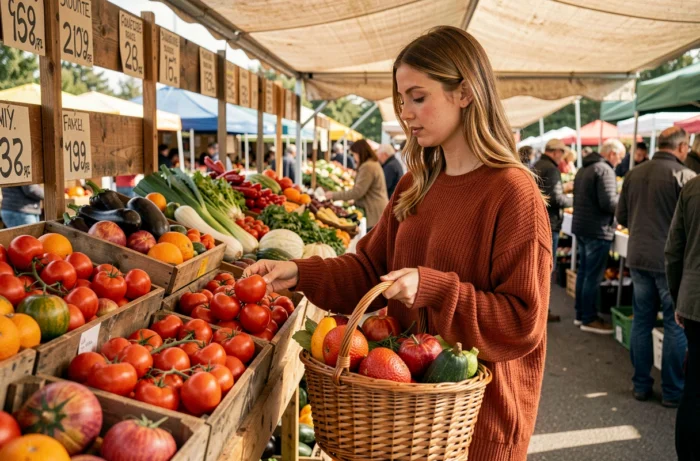
Cooking with seasonal products is not just a matter of ethics or budget. A vegetable harvested at maturity contains more natural sugars and aromas, reducing the need for complex seasonings. A peak-season tomato, simply sliced with salt and oil, surpasses in flavor a recipe made with winter greenhouse tomatoes.
For weeknight meals, the most effective reflex is to build the menu around two or three seasonal vegetables rather than around a protein. The sides become the centerpiece of the dish, with meat or fish as a complement. This reversal simplifies shopping and naturally diversifies meals.
The available data on the air fryer and anti-ultra-processed cooking shows that cooking tips are evolving rapidly. The actions that make a difference in daily life are no longer the same as they were five years ago. Adapting one’s habits to these changes, even gradually, transforms the quality of home-cooked meals without requiring more time.