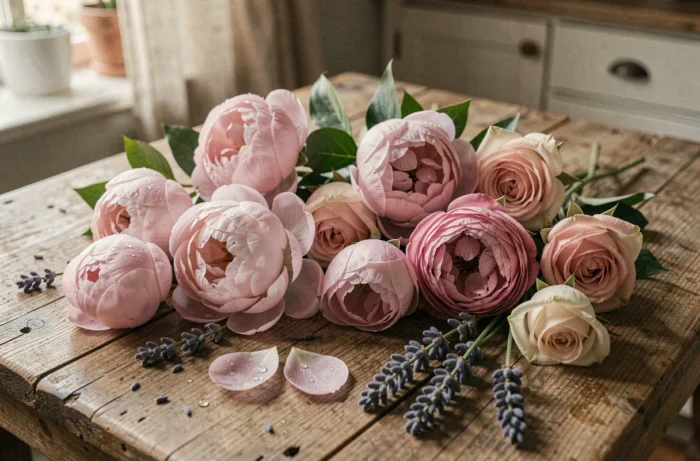
The language of flowers as it is practiced today has little to do with Victorian codes. Purchase data by occasion (mourning, Valentine’s Day, birth) reshapes the actual symbolism of varieties, well beyond traditional floral dictionaries. We observe an increasing gap between the literary meaning attributed to a flower and the concrete reason for which it is purchased.
Pesticide residues on cut flowers: a regulatory blind spot
The majority of cut flowers sold in France are imported, and there is no specific regulation governing pesticide residues on these retail products. ANSES was contacted in December 2024 on this subject, marking a first step towards a regulatory framework.
This gap has direct consequences on marketing discourse. The image of purity, innocence, or freshness associated with the white lily or peony relies on aesthetics, not on a health guarantee. Professionals who describe their bouquets as “natural” or “pure” expose themselves to an increasing risk, especially since the adoption of European directive 2024/825 on ecological claims, applicable from September 2026.
We recommend that florists clearly distinguish the cultural symbolism of a variety from the verifiable characteristics of the product sold. A lily symbolizes purity in the floral language. This says nothing about its growing conditions.
Color symbolism and actual buying behavior
Floral guides repeat that the red rose signifies passionate love, the white one purity, and the yellow one friendship. This coding remains effective, but it masks a more nuanced commercial reality. To delve deeper into each variety and its place in contemporary symbolism, the flowers on L’Herbe sous le Pied offer a detailed panorama that intersects botany and cultural uses.
Color often takes precedence over variety in the purchasing decision. A customer looking for a bouquet for a birthday first chooses a color palette (warm tones, pastels, bright colors) before considering the names of the flowers. Online sales platforms exploit this behavior by organizing their catalogs by dominant color rather than by species.
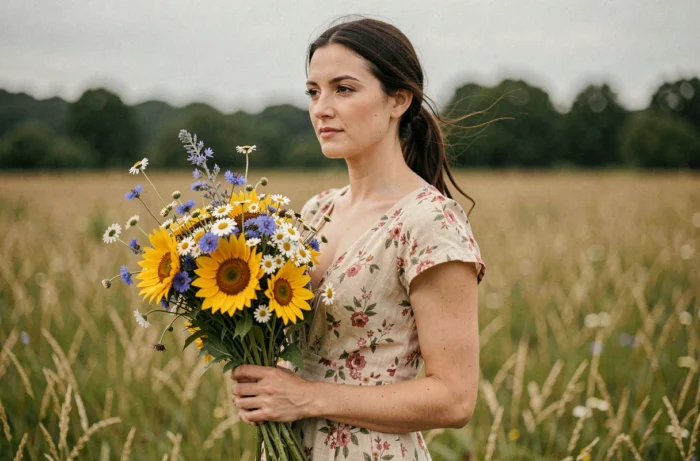
Some color-occasion correspondences remain stable in purchase data:
- Red accounts for the majority of sales around Valentine’s Day, driven by the rose but also by the tulip and red amaryllis, which are gaining ground
- White dominates funeral orders and weddings, with the lily, arum, and white rose as pillars
- Pastel tones (powder pink, peach, lilac) are overrepresented for births and Mother’s Day, with the peony and ranunculus leading the way
- Yellow, despite its theoretical association with joy, remains underrepresented in purchases, likely due to a lingering ambiguous connotation (jealousy, separation in certain traditions)
This gap between literary symbolism and commercial reality deserves to be integrated by florists who compose their seasonal displays.
Flower varieties and seasonality: how availability changes symbolism
The peony has become one of the most sought-after flowers for high-end bouquets. However, its window of availability in local production remains short: a few weeks between May and June. For the rest of the year, it is imported, often from the southern hemisphere, with a carbon footprint and cost that transform its social meaning.
Giving peonies in December is a marker of budget, not floral symbolism. The same reasoning applies to lily of the valley outside of May 1st, or tulips in the middle of summer. Seasonality redefines the message conveyed by a bouquet as much as the choice of variety.
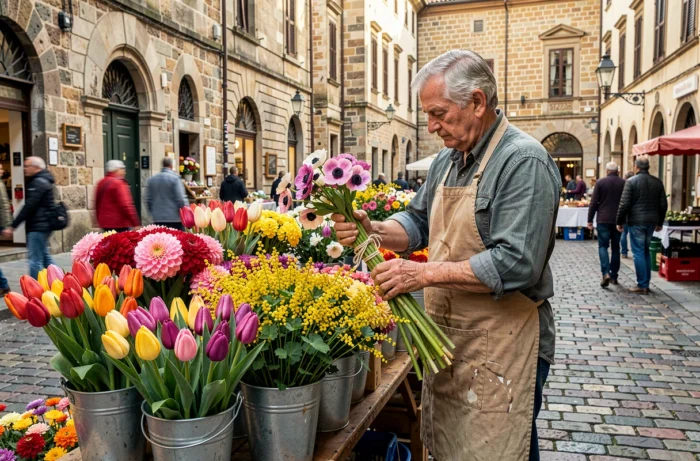
Varieties available year-round (rose, carnation, chrysanthemum, gerbera) carry a more stable symbolism because they are not subject to this seasonal rarity effect. The chrysanthemum, strongly associated with mourning in France, retains this connotation precisely because it is available in November, during All Saints’ Day. In other cultures, the same flower symbolizes longevity or joy.
The meaning of a flower depends as much on geography and the calendar as on the floral dictionary.
Rose, lily, orchid: three distinct registers of floral language
Rather than an exhaustive catalog, we detail three varieties that illustrate fundamentally different symbolic registers.
The rose functions as a chromatic vocabulary. Its meaning changes with its color, size (bud, open flower, garden rose), and quantity. It is the only flower whose quantity explicitly modifies the message in Western floral tradition.
The lily operates in a sacred and ceremonial register. Its presence in Christian religious iconography makes it a symbol of purity that transcends trends. It remains the most used flower in funeral compositions and religious wedding ceremonies, a cultural anchor that fashion does not displace.
The orchid occupies an aesthetic and status register. Its symbolism (refinement, seduction, exoticism) is less codified than that of the rose, but its price and longevity make it a gift that communicates social positioning as much as a sentiment.
These three registers (chromatic, ceremonial, status) cover the majority of purchasing situations. Other popular varieties (tulip, peony, sunflower, ranunculus) relate to one of these three axes depending on the context.
The beauty of a flower lies not only in its shape or color. It also depends on the accuracy of the message it conveys in a specific context. A bouquet of sunflowers for a funeral or a chrysanthemum for a declaration of love sends contradictory signals that nullify the intention of the gesture. Knowing the symbolic register of a variety avoids these missteps far more reliably than a list of definitions learned by heart.