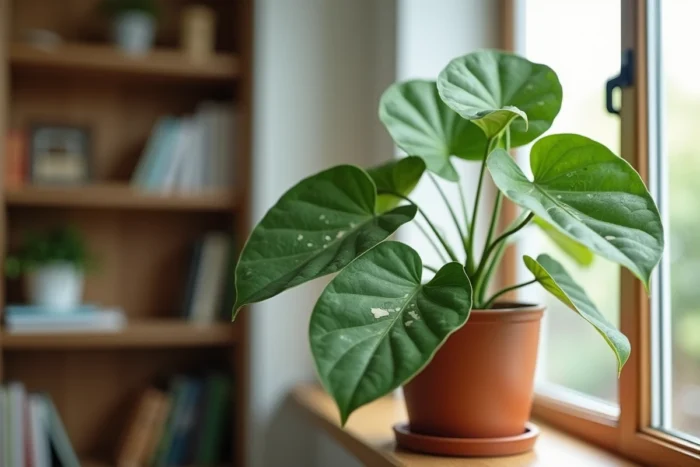
We take a houseplant out onto the balcony at the first ray of sunshine, and three days later the leaves turn white. Or we notice a powdery film on a rose bush that was doing very well the previous week. The whitening leaves signal a specific problem, sometimes several combined, and the response entirely depends on the initial diagnosis.
Light stress and sunburn on leaves
The most common and misunderstood case concerns plants abruptly moved from indoors to full sun. The leaf tissues have not had time to produce enough protective pigments. The result: whitish or grayish areas appear within a few hours, especially on the upper side of exposed leaves.
This phenomenon is observed in both tropical plants (ficus, anthurium, passionflower) and vegetable plants that have been taken out of the greenhouse too quickly. The affected leaves do not regain their color. They are literally cooked.
To explore the causes of white-leaved thoughts in more depth, we find that thermal stress related to heat waves has significantly amplified the problem in recent years, with burns even on plants already acclimated to the outdoors.
The solution is simple but requires discipline: acclimate any plant gradually over one to two weeks. Start with exposure to light shade, then to partial shade, before considering direct sunlight. During periods of intense heat, a light shading cloth also protects plants that have been established for a long time.
Powdery mildew and fungi: recognizing white powder on plants
When the white does not limit itself to localized spots but forms a uniform powdery veil on the foliage, we are facing a fungus. Powdery mildew remains the main culprit. It develops in mild, dry weather with moderate humidity, which surprises many gardeners who associate fungal diseases with rain.
The affected plants are numerous: roses, zucchinis, vines, currant bushes, but also some houseplants in poorly ventilated rooms. The fungus colonizes the leaves, stems, and sometimes flowers, causing the foliage to curl and then dry out.
Differentiating powdery mildew from soil mold
The white mold that forms on the surface of the potting soil has nothing to do with powdery mildew. It is generally made up of saprophytic fungi that decompose organic matter. They are harmless to the plant. They can be removed simply by scraping the surface of the substrate and improving ventilation.
Powdery mildew, on the other hand, attaches directly to the green parts of the plant. When you run your finger over an affected leaf, the white powder partially wipes away, but the tissues underneath are already damaged.
Natural fungicide treatment for powdery mildew
Two approaches work in a curative manner:
- A spray of wettable sulfur slows the progression of the fungus, provided that it is not applied in full sun to avoid additional burns on the foliage
- Diluted potassium bicarbonate in water alters the surface pH of the leaves and makes the environment hostile to powdery mildew
- A horsetail decoction, used preventively, strengthens the resistance of leaf tissues due to its silica content
Preventively, spacing plants to promote air circulation significantly reduces attacks. It is also advisable to avoid watering the foliage at the end of the day.
Mealybugs and white deposit parasites
Another scenario often goes unnoticed: mealybugs. These insects attach themselves to the stems and the axils of the leaves, producing a white cottony mass that is easily confused with mold. Upon closer inspection, small oval bodies can be distinguished beneath the waxy layer.
Mealybugs weaken the plant by sucking its sap. They also secrete honeydew, a sugary liquid that attracts sooty mold (a black fungus). Thus, we go from a problem of white leaves to black leaves if not treated in time.
The most effective treatment indoors remains a mixture of warm water, liquid black soap, and a spoonful of rubbing alcohol, applied with a brush directly on the colonies. Repeating the operation every five to seven days for three weeks helps break the reproductive cycle.
Nutrient deficiency and leaf chlorosis
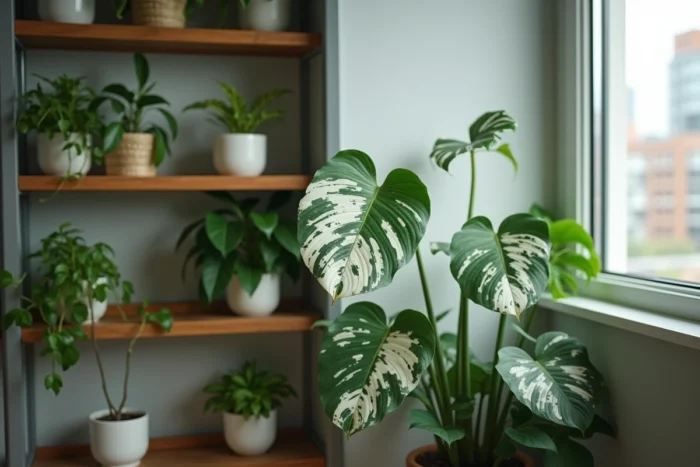
Leaves that gradually pale, starting with the veins or edges, often signal a deficiency. Iron and magnesium are the two elements whose lack causes marked discoloration of the foliage, sometimes to the point of white on young shoots.
This problem frequently affects plants grown for a long time in the same substrate without fertilizer, or those watered exclusively with very hard tap water. The hardness blocks the absorption of iron at the roots, even if the soil contains it.
- Check the pH of the substrate with a basic kit: a pH above 7 promotes iron chlorosis
- Provide a fertilizer rich in chelated iron, directly assimilable by the roots
- Switch to less hard watering water (rainwater, filtered water) for sensitive plants like hydrangeas, azaleas, or citrus
Repotting in fresh, suitable substrate sometimes resolves the problem without any addition of fertilizer, especially if the plant has not been repotted for several years.
Identify the cause before treating white leaves
We summarize the approach starting from what we observe. Dry and localized spots after sun exposure point to a burn. A powdery veil over the entire foliage indicates powdery mildew. Cottony masses in the corners of the plant reveal mealybugs. A gradual and uniform pale appearance suggests a nutrient deficiency.
The classic trap is to treat with a fungicide a plant that is actually suffering from excess light, or to increase fertilizer on a plant attacked by pests. Each white symptom has its own logic and treatment. Taking five minutes to observe the location, texture, and progression of the whitening avoids weeks of poor care.