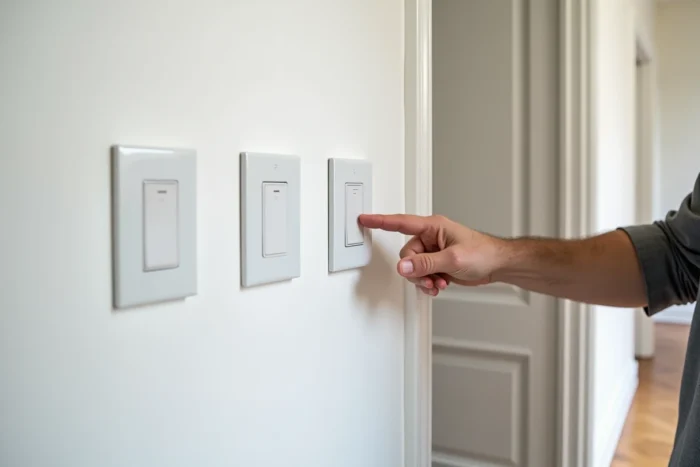
At Legrand, each range of switches is based on a three-piece assembly system: a mechanism, a mounting support, and a finishing plate. This common principle masks major differences in terms of installation, customization, and price. Céliane, Mosaic, and Neptune cover three distinct segments, from high-end residential to budget-friendly devices.
The choice between these ranges depends less on personal taste than on technical constraints: type of installation (flush-mounted or surface-mounted), compatibility with a conduit, number of positions to align, and the presence or absence of connected functions.
1. Céliane: the Legrand switch focused on design and home automation

Céliane is the most extensive residential range in the Legrand catalog. Its distinctive feature is the interchangeable finishing plate, available in a wide variety of materials and colors. Titanium, leather, glass, wood: the choice goes beyond the simple white/ivory opposition found in entry-level ranges.
This customization comes at a cost. For the same function, a Céliane two-way switch is significantly more expensive than a Neptune or Mosaic. The plate is sold separately from the mechanism, allowing for style changes without touching the wiring, but requiring the purchase of each component individually.
Legrand now positions Céliane as a range that is as functional as it is aesthetic. The catalog includes connected switches compatible with Netatmo, LED dimmers, roller shutter controls, and USB sockets. For a project where home automation needs to integrate into the wall-mounted devices without an external box, Céliane remains the only Legrand range to offer this depth of functions. Before finalizing a selection, it is possible to estimate a project on Rêves de Déco to compare the overall budget between ranges.
The downside: installation requires more care. The mechanism fits into a standard box, but aligning the plate on a multi-position setup demands precision. In renovations, the tolerances of old flush-mount boxes can complicate installation.
2. Mosaic: the modular Legrand switch range for all environments

Mosaic has long been perceived as a range reserved for tertiary sectors (offices, hotels, healthcare facilities). Legrand’s current catalog positioning corrects this image. Mosaic also targets residential, with a clean and modern white design that fits all rooms in a house.
The main advantage of Mosaic is its modularity. The module system (from 1 to 10 modules per position) allows for the assembly of heterogeneous functions on the same support: a 2P+T socket next to an RJ45 socket, switch and dimmer on the same frame. This flexibility is rare in traditional residential ranges.
Mosaic also stands out in terms of installation constraints. The range is compatible with the main conduit and molding systems, making it a relevant technical choice in renovation projects where concealed cable routing is excluded. Key points to remember:
- Native conduit compatibility, whereas Céliane typically requires flush installation in most cases
- Interchangeable and combinable modules on the same support, reducing the number of fixing points
- Intermediate price, lower than Céliane but higher than Neptune for the same function
Aesthetic customization remains limited compared to Céliane. Mosaic plates primarily come in white, with a few additional finishes. For a project where design is paramount, Mosaic will be limited.
3. Neptune: the budget-friendly Legrand switch for new builds and renovations

Neptune occupies the entry-level segment at Legrand. The design is simple, featuring a softened white and straightforward lines. No interchangeable plate, no combinable modules: Neptune covers basic functions (two-way, push-button, 2P+T socket) without frills.
This positioning is not a drawback. To equip an entire home with functional switches and sockets, Neptune allows for a controlled budget without sacrificing Legrand’s reliability. The mechanisms use automatic terminals that speed up connections, a tangible advantage in new construction where the volume of points to wire is high.
Limitations appear as soon as one deviates from the standard:
- No connected functions or dimmers in the Neptune catalog
- No modular multi-position version comparable to Mosaic
- Unique finish, with no option for plate customization
- Function catalog limited to common electrical controls
Neptune is suitable for technical rooms (garage, laundry room, cellar) or projects where the equipment needs to remain discreet and budget-friendly. In the same home, there is nothing to prevent mixing Neptune in service rooms and Céliane in living spaces, provided the compatibility of the flush-mount boxes is verified.
The choice between these three ranges boils down to a simple grid: Céliane for design and home automation, Mosaic for modularity and conduit compatibility, Neptune for budget. The best approach often involves mixing the ranges according to the rooms rather than imposing a single range throughout the entire home.