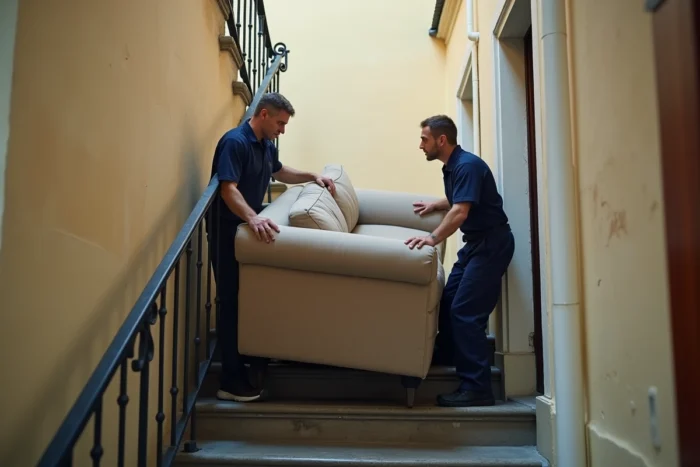
An angled sofa stuck in a staircase, a wardrobe refusing to cross a landing: these situations occur more often than one might think during a move. The problem almost never comes from the weight of the furniture, but from a lack of anticipation regarding the actual dimensions of the passage. Knowing precisely what measurements to take, and especially how to compare them to the dimensions of the furniture, saves hours on moving day.
Diagonal measurement of the furniture: the criterion that product sheets omit
The width, height, and depth of a piece of furniture are listed on most technical sheets. The diagonal measurement, however, rarely appears, even though it determines whether an object can be tilted to pass through a narrow passage.
For a sofa, the diagonal is calculated between the bottom of the backrest and the opposite upper corner of the seat, once the furniture is tilted on its side. It is this measurement, not the total height, that should be compared to the width of the staircase. For a non-dismantlable wardrobe, the diagonal connects the lower front corner to the upper back corner.
Before taking any measurements in the staircase, it is essential to create a sheet for each critical piece of furniture: overall dimensions, diagonal in tilted position, estimated weight, possibility of disassembly. Professional movers recommend doing this work several weeks before moving day, not the day before. According to the technical guide from Avis Déménagements, this verification should occur six to eight weeks before the scheduled date, as the resulting decisions (renting a lift, disassembly, temporary storage) take time.
When you need to measure a staircase before a move, this sheet for each piece of furniture becomes your reference for comparison at each passage point.
Staircase: the measurements to take and their order of priority
A staircase is not just a width between two walls. Several measurements interact, and it is their combination that determines whether a piece of furniture passes or gets stuck.
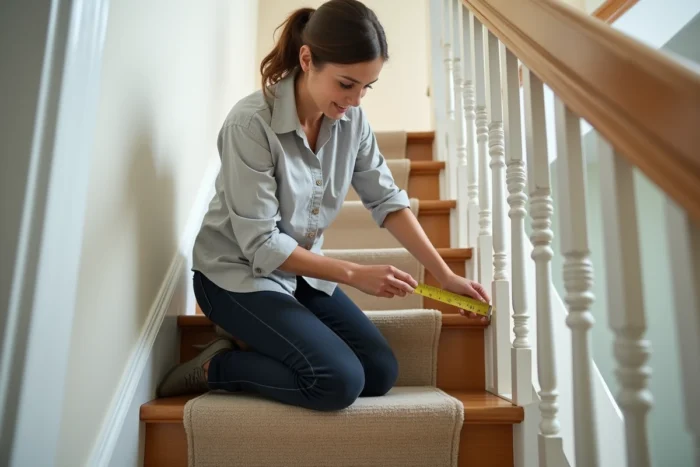
Usable width between the railing and the wall
Place the tape measure between the inner face of the railing (or guardrail) and the opposite wall. Do not measure between the two walls: the railing reduces the actual width by several centimeters. In some older staircases, the handrail is fixed protruding, which further reduces the available space.
Height under the ceiling in corners
Intermediate landings and quarter turns often have a lower ceiling than the rest of the staircase. Measure the height at the most constrained point, usually the inner angle of the turn. This is where wardrobes and refrigerators get stuck, even when the width seemed sufficient.
Depth of the turning landing
The depth of the landing determines the pivoting capacity of a long piece of furniture. A two-meter sofa cannot pivot in a landing that is one meter twenty deep, regardless of the width of the staircase. Measure this depth including the available wall space on each side.
The measurements to systematically take:
- Width between the railing and the wall at mid-flight, then at the landing (the two values often differ)
- Height under the ceiling at the lowest point of the turn or intermediate landing
- Depth of the turning landing, measured perpendicular to the next flight
- Width of the apartment’s entrance door, measured between the interior frames, minus two centimeters for handling margin
Spiral staircase and helical staircase: specific constraints for moving
A straight staircase with a landing poses pivoting problems. A spiral staircase poses problems of continuous curvature, which radically changes the measurement method.
On a spiral staircase, the usable width varies at each step: wide on the wall side, narrow on the central core side. Only the width at the inner third of the step matters for the passage of a piece of furniture, as this is the trajectory that the carrier actually takes. Measuring at the center of the step gives an overly optimistic value.
The height between two stacked flights constitutes the other major constraint. On a helical staircase, this height corresponds to the headroom (the vertical distance between the nose of a step and the underside of the upper flight). If the headroom is less than the height of the tilted furniture, passage is physically impossible without disassembly.
In recent compact housing, staircases tend to be narrower and steeper than before. Buildings optimize living space at the expense of vertical circulation, complicating the passage of furniture that is considered standard.

Comparing measurements: method for checking furniture piece by piece
Once you have the measurements of the staircase and the furniture, the comparison follows a precise logic.
For each piece of furniture, first identify its optimal passage position. A sofa generally passes on its edge (backrest down). A wardrobe can sometimes pass tilted diagonally if the ceiling allows it. The furniture must be able to pivot at each change of direction without touching the wall or ceiling.
- Compare the diagonal of the furniture to the usable width of the staircase: the diagonal must be at least two centimeters less
- Check that the length of the furniture is compatible with the depth of the turning landing
- Control the height of the tilted furniture in relation to the headroom or ceiling of the turn
- If any one of these three checks fails, plan for disassembly or an external lift
On the other hand, if the furniture is dismantlable, the comparison focuses on the largest element once disassembled. A king-size bed whose base folds in half can navigate staircases that would block the same rigid base.
The two-centimeter margin is not an arbitrary convention. It absorbs the imperfections of the walls’ plumb, the thickness of protections (blankets, boxes), and micro-adjustments of angle during handling. Below this margin, the risk of damage to the furniture or walls increases significantly.
When the measurements are too tight to decide based on plans, a physical simulation with a cardboard cutout to the dimensions of the furniture allows for testing the actual passage. This verification takes a few minutes and avoids mobilizing a team of movers for a piece of furniture that will ultimately remain at the bottom of the staircase.