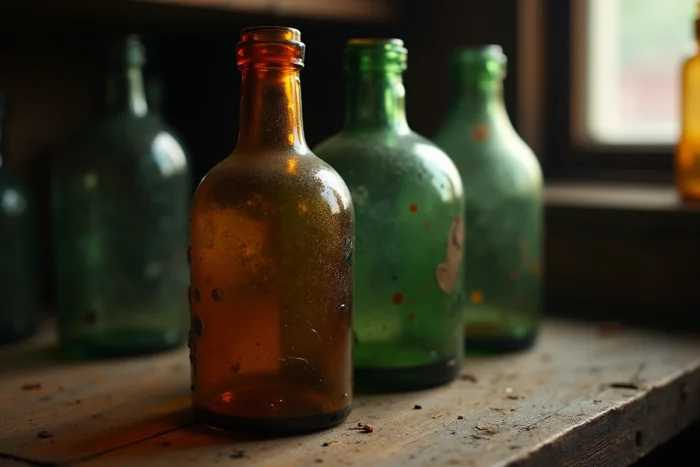
Glass does not decompose, or if it does, it does so so slowly that each bottle retains traces of its manufacture for centuries. Recognizing the age of a glass bottle relies on observing these traces: type of seam, shape of the bottom, color of the material, glassmaker’s marks. No single clue is sufficient, but their combination allows for a reliable approximate dating.
Mold seam and joint line: the first technical clue
The seam line running along the bottle is the most telling marker for estimating a manufacturing period. On a mouth-blown bottle, this line stops well below the lip, often at the shoulder. The neck was then shaped by hand, leaving an irregular surface to the touch.
Bottles produced by semi-automatic machines have a seam that rises to the neck without reaching the top. This type of manufacturing corresponds to a period of industrial transition. When the joint line runs from the bottom of the bottle to the upper edge of the lip without interruption, the bottle was produced by an automatic machine, placing it in a more recent period.
To properly utilize this clue, as detailed in the Jardindivert guide, one must run a finger along the seam and precisely note where it disappears. A sharp interruption below the neck indicates an old handmade production, while a continuous and regular seam signals industrial molding.

Color of old glass: what the hue reveals about the era
The color of a bottle is not just an aesthetic question. It directly depends on the raw materials and melting techniques available at a given time.
Old glass often displays unintentional hues. An aqua or pale blue-green glass results from the natural presence of iron in the sand used. This uncontrolled coloration is characteristic of the oldest productions. Glassmakers then learned to add manganese to neutralize this hue and achieve clear glass.
A lesser-known detail concerns originally clear glass bottles that have turned violet or amethyst. This transformation occurs when the manganese contained in the glass reacts to prolonged exposure to ultraviolet rays. Observing a purple hue on a supposed clear glass constitutes an interesting dating clue, as this manganese clarification technique was used for a limited period.
The most common colors on recent bottles (olive green, dark amber, perfectly uniform clear glass) indicate modern manufacturing processes with precise chemical control of coloration.
Glassmaker’s marks and bottle bottom: decoding the inscriptions
The bottom of a bottle contains several technical pieces of information. Sometimes it features a glassmaker’s logo, a mold number, or a combination of both. There is a strong temptation to try to date the bottle based on a simple number engraved in the glass.
However, glassware specialists warn on this point: a mold number alone does not allow for dating a bottle. These numbers are internal catalog references, reused by manufacturers with no direct link to the year of production. Thousands of models share similar numbering.
The effective approach is to identify the manufacturer’s logo rather than the number. Online specialized databases, such as the one on the GlassBottleMarks site, catalog the evolution of glassmaker logos over long periods. Each graphic modification of a logo corresponds to a documented time range. Cross-referencing this logo with the shape of the bottle and its manufacturing technique refines the dating.
Pontil and flat bottom: two generations of bottles
The bottom of the bottle provides another clue. Old blown bottles often feature a pontil mark: a rough scar or glass residue where the blowing rod was attached. This mark disappears with industrialization, replaced by a smooth and regular bottom that sometimes bears a raised logo.
A perfectly uniform bottom, with clear molded inscriptions, indicates mechanized production. An irregular bottom with a central residue points to handmade production.
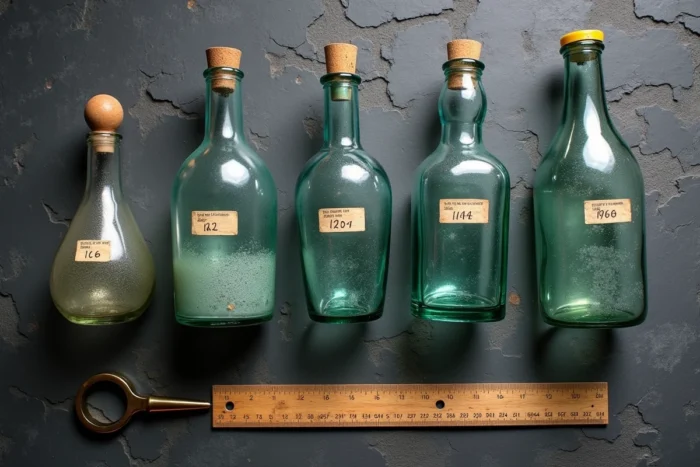
Cross-referencing clues to date a glass bottle
No single criterion taken in isolation provides reliable dating. The most robust method is to cross-reference several simultaneous observations. Here are the criteria to systematically examine:
- The height of the mold seam on the body of the bottle (handmade, semi-automatic, automatic)
- The color of the glass and the possible presence of a purple or aqua hue indicating a dated chemical composition
- The marks on the bottom (pontil, identifiable glassmaker logo, mold number) cross-referenced with a specialized database
- The overall regularity of the bottle: trapped air bubbles, asymmetry of the neck, uneven thickness of the glass, all signs of handmade production
A bottle that features a low seam, an unintentional aqua hue, a marked pontil, and trapped air bubbles in the glass accumulates clues of old production. Conversely, a perfectly symmetrical bottle, with a complete seam and a clear molded bottom, belongs to industrial production.
Label and cork as complementary clues
The label, when it remains, provides useful reference points. The type of paper, printing technique, and graphic style help narrow the dating range. The cork also provides information: an irregular natural cork points to a different period than a standardized metal cap.
These elements remain secondary compared to the characteristics of the glass itself, as labels and corks may have been replaced. The glass, however, indefinitely retains traces of its manufacture, making it the most reliable dating medium for any old bottle.