
The hedge trimmer market is undergoing a silent transformation. Since 2025, the Sustainable Gardener Bonus funds up to 25% of the purchase price of labeled electric or manual tools, capped at 300 euros per household per year. For low-income households or those in densely populated urban areas, the coverage can rise to 40%. This scheme, linked to the France Nature plan, reshuffles the cards between thermal and electric power sources.
Sustainable Gardener Bonus and battery hedge trimmers: what the subsidy changes
Most guides compare power sources based on technical criteria. They overlook a parameter that has become crucial: the actual cost after public aid.
The Sustainable Gardener Bonus imposes several conditions. You must provide a named invoice indicating the ecological nature of the tool, proof of residence, and a bank account statement. In some cases, proof of the destruction of an old thermal device is required. The aid is paid after purchase, upon submission of receipts, which means you must cover the total amount upfront.
This post-purchase reimbursement mechanism introduces a rarely mentioned criterion: the ability to finance the purchase before being reimbursed. A high-performance battery model costs significantly more than an entry-level wired model. With the subsidy, the gap narrows, but you need to be able to pay the amount upfront. To compare available models and their prices, specialized catalogs like the one offered on taille-haie-warrior.com help assess the necessary budget before preparing a grant application.
Thermal or battery power: what are the field returns saying
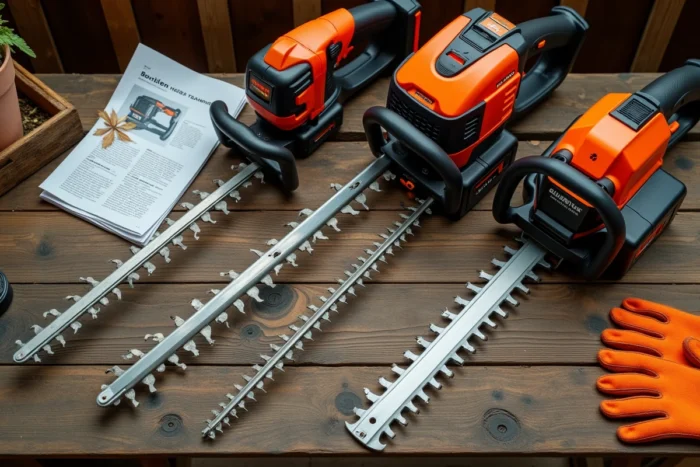
Experience feedback shared in gardening and landscaping groups since 2024 shows a clear trend. Battery pole hedge trimmers are gaining ground among private users. Satisfaction is based on low noise levels, the absence of fumes, and maneuverability at height.
However, field feedback diverges on one specific point: actual autonomy in dense cutting conditions. An old, thick hedge with large-diameter branches demands much more from the battery than a young hedge of thujas. Users who trim large linear areas sometimes report the need for a second battery, which increases the initial budget.
The thermal motor retains an advantage for very long rural hedges or jobs without access to an electrical outlet. Its superior torque on thick branches remains a real technical argument. The trade-off is weight, noise, engine maintenance (spark plug, filter, oil change), and the inability to benefit from the Sustainable Gardener Bonus.
The case of the wired hedge trimmer
Often excluded from discussions, the wired model remains the cheapest to purchase and the lightest. Its limitation is physical: the electrical extension. For a modest-sized garden where the hedge runs along the house, it is a pragmatic option that many comparisons underestimate. The wired model is suitable for short hedges close to a socket, without autonomy constraints or battery costs.
Blade and cutting capacity: the criteria that the technical sheet doesn’t mention
The blade length is listed on all product sheets. What is less often mentioned is the spacing of the teeth, which determines the maximum branch diameter that the tool can cleanly shear.
- A reduced spacing (around 15 to 20 mm) is sufficient for a regularly trimmed privet, boxwood, or young laurel hedge
- A wider spacing (beyond 25 mm) becomes necessary for rural hedges, old hornbeam, or hardwood shrubs that haven’t been trimmed for several seasons
- Double-action blades (both blades move simultaneously) reduce vibrations and provide a cleaner cut than single-action blades, where only one blade slides over the other
The spacing of the teeth determines the type of hedge you can maintain. Buying a model with a narrow spacing for a dense and old hedge forces the tool and risks constant clogging.
The blade length, on the other hand, involves a trade-off between comfort and precision. A long blade covers more surface area in one pass but is heavier and makes shaping cuts (rounded edges, narrow tops) more delicate. For shrub sculpting or trimming low hedges, a short blade offers superior control.
Weight, ergonomics, and rotating handle: what matters over time
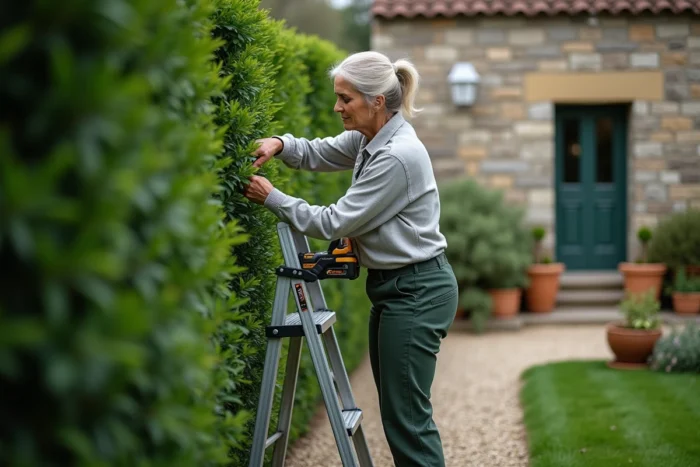
A hedge trimmer is held out at arm’s length, sometimes for over an hour. The weight displayed on the label tells only part of the story. The distribution of mass, the position of the handle, and the presence of a rotating handle radically change the comfort of use.
A pivoting handle allows you to trim the sides and top without twisting your wrists. On models lacking this feature, vertical cuts (sides of the hedge) impose awkward postures that fatigue the forearms and shoulders within a few minutes.
Models with telescopic poles add an additional parameter: the leverage. The longer the pole, the greater the torque exerted on the arms. Some manufacturers include a shoulder harness to compensate, while others do not. Checking for this accessory before purchase avoids unpleasant surprises on tall hedges.
Trimming period and biodiversity
The French Office for Biodiversity recommends avoiding hedge trimming from March 15 to July 31, during the bird nesting period. This is not a legal prohibition for individuals, but a strong recommendation that influences the usage calendar, and thus the choice of tool. A hedge trimmer purchased in April will only be fully utilized starting in August, allowing time to compare and prepare a grant application.
The choice of a hedge trimmer is not limited to a specification grid. The type of hedge, its height, age, planned maintenance frequency, and garden layout weigh as much as the motor power. With current public aids, the battery model becomes competitive for the majority of urban and suburban gardens, provided you anticipate the cash advance and check the blade spacing suitable for your vegetation.