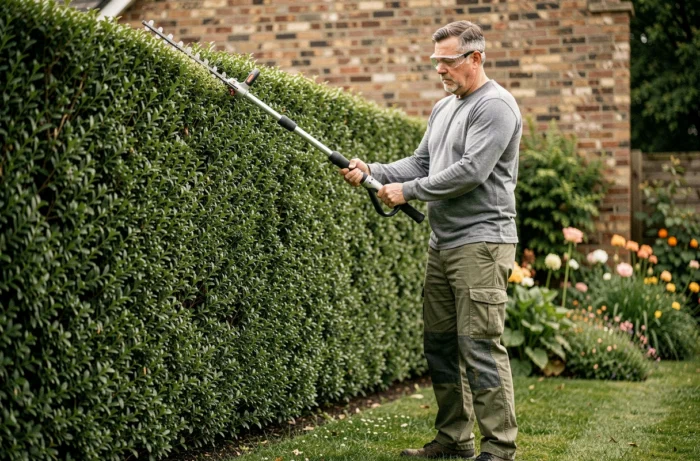
Trimming a hedge that exceeds two meters in height with a standard hedge trimmer requires getting out a ladder, working with arms raised, and accepting an uneven cut on top. The telescopic hedge trimmer addresses some of these issues by adding an extendable tube and an adjustable head. The question remains which one to buy and how to use it without damaging the hedge, the neighborhood, or your joints.
Weight and balance of the telescopic hedge trimmer: the criterion not shown in the technical sheet
On a standard hedge trimmer, the weight is distributed between both hands, close to the body. On a telescopic model, the blade is at the end of a pole of one meter or more. The lever arm changes everything: a device weighing a few kilograms becomes cumbersome after ten minutes if the center of gravity is too far forward.
Manufacturers display the total weight, including or excluding the battery. This figure says nothing about the actual feel. Two models with the same weight can offer very different comfort depending on the position of the motor (at the top near the blade or at the bottom near the handle) and the presence of a harness or shoulder strap.
Before buying, hold the device with arms extended horizontally for about thirty seconds. If fatigue sets in quickly, imagine a full trimming session. User feedback varies on this point: some prefer a heavier but better-balanced model to a lighter model whose blade “dives” towards the ground as soon as pressure is released.
Comparative sheets available on taille-haie-telescopique.com allow you to cross-reference this technical data before heading to the store.
Battery, corded or gas: which motor for trimming at height
The type of power supply determines autonomy, noise, and weight. On a telescopic model designed for tall hedges, each parameter takes on particular importance.
Battery-powered telescopic hedge trimmer
This is the segment that is progressing the most. The absence of a cord simplifies movement around the hedge, a real advantage when working at height and a taut cable between the legs creates a risk of falling. However, the autonomy of a lithium-ion battery decreases significantly when the blade encounters thick branches or hard wood. For a long or dense hedge, a second battery is often necessary.
Corded (electric) telescopic hedge trimmer
The corded model offers constant power without time limits. Its main drawback is the electric extension cord, which complicates work at height and requires staying close to a power outlet. For a modest-sized garden with an accessible hedge, it is a cost-effective option. Beyond a certain hedge length, managing the cable becomes a real hindrance.
Gas-powered telescopic hedge trimmer
The gas engine provides the highest power and is suitable for thick branches. The trade-off: a higher weight, more pronounced vibrations, and a significantly higher noise level. This last point is not negligible from a regulatory standpoint.
Fines and trimming periods: the regulatory framework to know
As of October 1, 2023, decree n° 2023-695 has reclassified neighborhood noise nuisances as 4th class offenses with a fixed fine of 135 euros, which can reach a maximum of 750 euros. Previously, it was classified as a 3rd class offense. A gas-powered telescopic hedge trimmer used outside the time slots authorized by the municipal order is therefore subject to significant penalties.
Hours vary from one municipality to another, but most prohibit the use of noisy equipment before 8:30 AM on weekdays, before 9 AM on Saturdays, and all day on Sundays. Check the order posted at the town hall or on your community’s website.
Moreover, the trimming period has a direct impact on wildlife. Bird nesting generally runs from March to mid-August. Trimming a tall hedge during this window risks destroying active nests. Resuming trimming is generally possible from the second half of August, and then in the fall before the first frosts.

Blade length and tooth spacing: adapting the tool to the hedge
The length of the blade determines the width of the cut in a single pass. A short blade offers more maneuverability for complex shapes. A long blade speeds up work on the flat surfaces of a straight hedge. For telescopic use on tall hedges, the criteria to check are as follows:
- The spacing of the teeth sets the maximum diameter of branches that the blade can cut cleanly. A wide spacing is suitable for vigorously growing hedges (thuja, laurel), while a narrow spacing provides a neater finish on fine foliage (privet, boxwood).
- Double cutting, where both blades move in opposite directions, reduces vibrations and prevents branches from being pushed away instead of being cut. On a telescopic tool held at arm’s length, double cutting significantly improves precision.
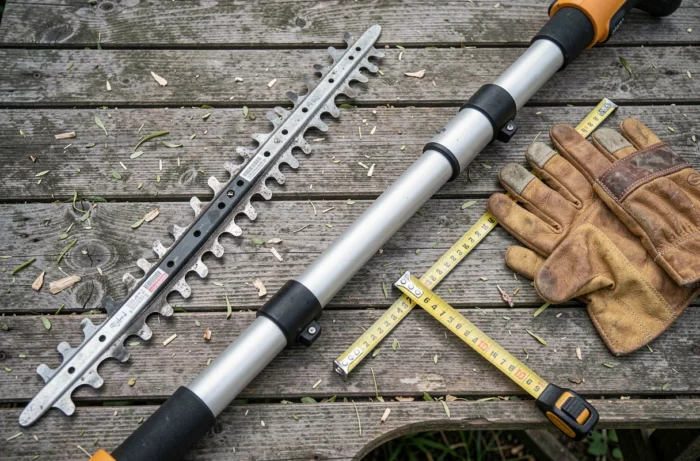
- The angle of the adjustable head allows you to trim the top of the hedge without tilting your body. Check the number of available positions and the ease of adjustment (button, dial, automatic notch).
Cutting technique at height: gestures and common mistakes
Working with a pole changes the usual references. The blade is far from the eyes, and the natural tendency is to push down to “sink” the tool into the vegetation. The result: torn cuts, rapid muscle fatigue, and an uneven hedge.
The effective gesture is to let the blade work by horizontal sweeping, slowly moving it from left to right (or vice versa) over the top of the hedge. The adjustable head, set at an angle close to 90 degrees relative to the tube, does the work for you. No need to press.
- Start with the sides of the hedge from the bottom, then finish with the top. This sequence prevents falling branches from obstructing the cutting of the lower parts.
- Keep the tube slightly tilted so that debris naturally slides to the ground.
- Only extend the pole to the necessary length. The shorter the pole, the more precise the control.
After each use, clean the blade with a cloth and apply a suitable lubricant. Residues of sap, especially on conifers, harden and dull the teeth if left to dry. Regular sharpening extends the life of the blade and reduces the effort required from the motor, which also preserves the battery life on cordless models.
The telescopic hedge trimmer remains a specialized tool. It does not replace a standard hedge trimmer for lower parts or a pruning shear for isolated thick branches. Combining it with the right gestures and the right trimming schedule is what makes the difference between a dense and even hedge and a blind-trimmed green wall.