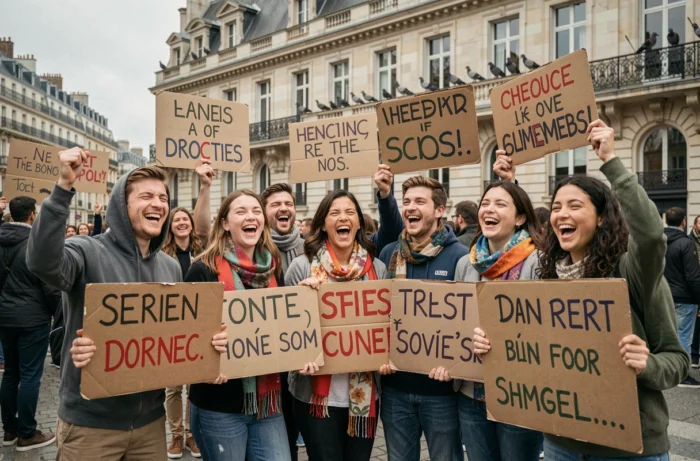
The word “cacaboudin” has no political charge in itself. It is a childish onomatopoeia, a playground curse that no one would spontaneously associate with a political party. Since 2024, this term has become a marker of opposition to the Rassemblement National, carried by digital communities that use it as a humorous password and as a slogan during physical gatherings.
Cacaboudin and the Politicization of Digital Cultures Against the RN
The phenomenon does not originate in a union leaflet or a press release. It emerges on Twitch, within communities of streamers and content creators who, since mid-2024, have taken an explicitly anti-far-right stance. The audiences are considerable: some activist live streams have gathered over one hundred thousand viewers live.
The choice of the word “cacaboudin” is not a coincidence. Its absurd and childish dimension makes it legally difficult to attack. Unlike a frontal insult, it works through derision, complicating any response from the targeted party. It is a diversion that borrows from internet meme codes: virality, repeatability, potential for visual variation.
As detailed in the article by Ker Expo on cacaboudin, the term quickly migrated from Twitch chats to protest signs and parodic domain names. This trajectory, from digital to street, illustrates a shift in the political role of content creators in France.
Anti-RN Mobilization: The Role of Content Creators in French Society

The rise of “cacaboudin” can only be understood by placing it within a broader movement. Since 2024-2025, gatherings bringing together several tens of thousands of people in Paris and other French cities have explicitly included content creators in their setups. These events mix protest-concerts, live activist panels, and slogans from social media.
This is no longer a niche anecdote. The boundary between internet culture and political action has blurred in this arena. Organizers of events “against hate” and “against the far-right” mobilize audiences who do not necessarily read daily newspapers but follow streamers for several hours a day.
Three elements distinguish this mobilization from previous anti-RN movements:
- The main vector is not a political party or a union, but web personalities who speak to a young audience, often distanced from traditional activist channels.
- The register is humor and absurdity, not programmatic discourse. “Cacaboudin” works because it makes people laugh, not because it argues.
- Virality is organic: no advertising budget, no campaign coordinated by an apparatus. The word spreads through imitation and community play.
This configuration raises a question that field feedback has not yet resolved: does viral humor produce lasting engagement or a fad that fades as quickly as it ignites?
Normalization Strategy of the Rassemblement National in the Face of Derision
The RN has been undergoing a pendulum movement between normalization and “re-demonization” for several years. The party leadership invests in a polished, professional image, free from the historical markers of the French far-right. This strategy has yielded electoral fruits.
However, recurring incidents undermine this image work. In September 2026, a municipal police officer in Carcassonne, a member of the RN’s security service, was suspended by the party after the dissemination of racist and sexist remarks captured by his own body camera. The case, reported by Le Monde, Mediapart, and Le Parisien, sparked widespread outrage and visible embarrassment within the party.
At the same time, the return of the debate on banning the wearing of the veil, described as “Islamophobic” by several political figures, rekindled accusations of discrimination. Le Parisien reported that the RN was reconsidering this proposal “at the risk of re-demonizing itself.”
It is in this context that “cacaboudin” gains its meaning. The word does not refute a program. It does not cite figures or legislative proposals. It operates on another level: that of image and ridicule. Against a party seeking respectability, derision attacks precisely what political argumentation does not touch.
Cacaboudin as a Societal Fact: Limits and Real Scope of the Movement

Transforming an absurd word into a political symbol has obvious limits. Derision mobilizes those who are already convinced. It creates internal cohesion, a sense of belonging, a shared language. There is no evidence that it changes the mind of an RN voter or a swing voter.
The history of social movements in France shows that humorous slogans can mark an era without necessarily impacting electoral results. The register of mockery has its own pitfalls: it can reinforce the feeling of contempt felt by supporters of the targeted party, thus consolidating their vote rather than weakening it.
The question of duration also arises. Memes have a short life cycle. “Cacaboudin” may remain a lasting cultural marker or disappear in a few months, replaced by another code word. The available data does not allow for a conclusion in either direction.
What remains factual: the word has crossed the barrier between the digital and the physical world, between entertainment and political action. It has been taken up in gatherings of several tens of thousands of people, adapted into domain names, visuals, and merchandise. Whether viewed as a serious political act or as a prolonged childish joke, the phenomenon documents a societal fact: the boundary between internet culture and political engagement no longer exists in France.