
A sports CV is not just about listing achievements or federal diplomas. Recruiters in the sports sector are looking for specific skills, often hybrid, that combine technical know-how and transferable skills. Understanding which skills weigh the most depending on the type of position allows for the creation of a document that captures attention from the very first seconds.
Digital and business skills in sports: what recruiters are looking for in 2026
Job postings published in 2026 in the sports business show a clear shift. According to Win Sport School, employers are now seeking skills in social media, content creation, SEO, digital advertising, marketing data analysis, CRM, and collaborative tools. These are no longer bonuses but prerequisites for many positions related to sports marketing, club communication, or event management.
The CNOSF, in its listings shared in July 2026, explicitly mentions network management, project management, and proficiency in Microsoft 365, Teams, and SharePoint. A candidate applying in the institutional sports movement without displaying these operational skills misses out on concrete selection criteria.
Sports-Insiders.net confirms this trend: the sector is increasingly recruiting hybrid profiles such as data analysts, AI experts, and compliance officers. These jobs did not exist in sports a few years ago. A sports CV that only mentions teamwork and perseverance, without measurable technical skills, risks being dismissed even before the interview.
To delve deeper into the selection of skills not to be overlooked, consulting a sports CV example with Career Trotter allows for visualizing how to structure these skills in a coherent document.
Technical skills versus transferable skills in a sports CV: comparison table

The distinction between hard skills and soft skills is well-known, but in the sports field, the boundaries are shifting. A sports coach must master training planning (technical) while also knowing how to manage a group under pressure (transferable). The table below classifies the most sought-after skills according to the type of position.
| Type of position | Priority technical skills | Expected transferable skills |
|---|---|---|
| Professional athlete | Measurable performances, federal certifications, physical preparation | Resilience, stress management, personal discipline |
| Coach | Training planning, video analysis, first aid | Leadership, communication, pedagogical adaptation |
| Sports educator | BPJEPS/DEJEPS diplomas, regulatory supervision, safety | Public speaking, written synthesis, listening |
| Sports marketing/communication | SEO, CRM, digital advertising, content creation | Teamwork, project management, creativity |
| Data/compliance in sports | Data analysis, AI tools, sports regulations | Rigor, critical thinking, autonomy |
Marketing and data positions require a majority of technical skills, while coaching or educational roles remain more balanced between the two categories. A sports CV gains impact when it reflects this distribution specific to the targeted position, rather than a generic list identical for all profiles.
Skills section of the sports CV: common mistakes and effective formulations
The skills section of a sports CV often suffers from the same flaw: vague terms that do not differentiate anyone. “Team spirit,” “motivation,” or “dynamism” appear on nearly all applications in the sector. These words convey no actionable information for a recruiter.
An effective formulation ties the skill to a measurable or verifiable context. Here’s the difference:
- “Team spirit” becomes “coordination of a group of 15 athletes during regional competitions”: the recruiter visualizes the scale and context.
- “Stress management” becomes “maintaining performance in the final phase of the national championship”: the skill is anchored in a concrete situation.
- “Digital skills” becomes “creation and management of content on the club’s social media, with proficiency in CRM and collaborative tools”: the technical scope is clear.
- “Leadership” becomes “technical supervision of weekly training sessions for a junior team”: the role is specified.
Each skill must be linked to an experience or a verifiable result. A recruiter in sports knows hollow formulas. They seek evidence of action, not statements of intent.
Adapting the professional experience section to the codes of sports recruitment
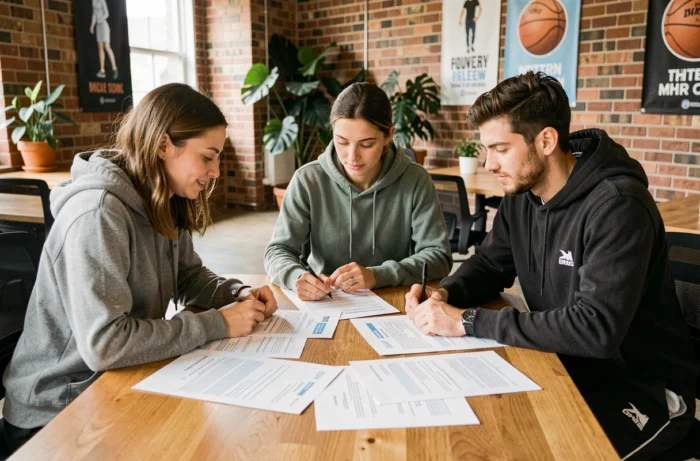
In a traditional CV, professional experience follows a standard reverse chronological order. For a sports CV, the competitive background and professional experience must coexist without cannibalizing each other. A high-level athlete who has spent ten years in competition cannot relegate this period to a “hobbies” section.
The most readable solution is to separate into two blocks: a “sports background” block detailing clubs, competition levels, and results, and a “professional experience” block for supervisory, training, or marketing positions held in parallel or after the sports career.
For profiles in transition, translating skills acquired in competition into professional terms remains the most underutilized lever. Managing an international competition calendar equates to multi-site project management. Negotiating sponsorship contracts falls under sales and business development.
The CNOSF listings in 2026 also mention public speaking and written synthesis among the expected skills. These abilities, often developed by athletes during interviews or season reviews, deserve explicit mention in the CV rather than being considered implicit.
A well-constructed sports CV does not merely display medals. It demonstrates, skill by skill, that the candidate masters the tools and methods required by the position. The difference between a CV that gets read and one that gets dismissed often lies in the precision of the formulations, not the number of lines.