
Contemporary poetry no longer resembles the alexandrines learned in school. It is read on a phone screen, listened to in a podcast, discovered at an outdoor festival. Understanding what is happening today in this universe requires looking at both the texts, the authors who carry them, and the spaces where they circulate.
Free verse and poetic prose: what defines contemporary poetry
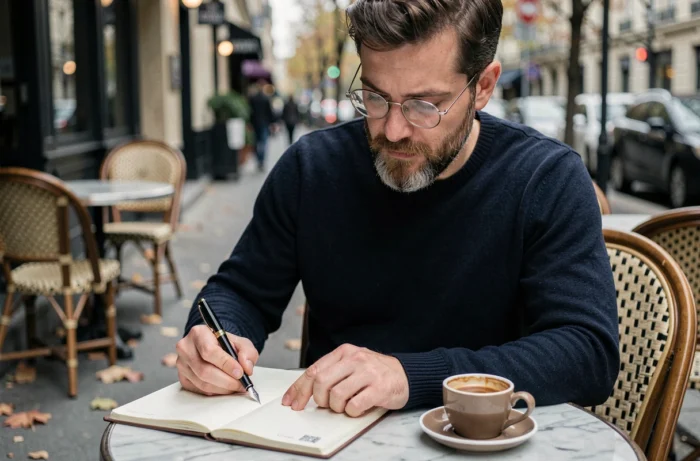
You have probably read a short text, without rhymes, divided into uneven lines, and wondered if it was a poem? This is often a sign that you are facing contemporary poetry. Formal constraint no longer defines the genre for several decades.
Today’s poets inherit all forms: classical verse, free verse, poetic prose. Most choose free forms. Some, like Philippe Jaccottet or Yves Bonnefoy, have favored a discreet lyricism, a celebration of the world through simple words. Others play with the language itself, exploring its deceptive dimension and ambiguities.
This diversity is the first characteristic of the genre. There is no single claimed movement, but rather divergent practices. A collection by Christian Bobin is nothing like a text by Sara Mychkine or the minute poems of Arthur Teboul. To explore this diversity and follow the news of Francophone poetry, a useful resource: https://www.soupir.org/.
This assumed prosaicism and refusal of conventional sentimentality give contemporary poetry an accessibility that many do not suspect.
Poetry book market: figures that tell a contrasting reality
Poetry faces a rarely documented paradox. In 2024, the National Book Center reported a 17% increase in poetry sales. The following year, this same sales figure dropped by 11.6%. This volatility reveals a very reactive market, capable of sudden peaks as well as rapid declines.
Despite the abundance of authors, poetry sales account for only about 1% of total book sales in France. Print runs remain very low. A collection printed in a few hundred copies is the norm, not the exception.
The abundance of poetic voices coexists with structural confidentiality. The mainstream press devotes little criticism to collections. The literary sections of national newspapers cover novels, sometimes essays, rarely poems. This gap between abundant production and reduced visibility is one of the most striking features of the current poetic landscape.
Contemporary Francophone poets: three voices to know
Rather than a long list, let’s focus on three authors whose work illustrates very different directions in Francophone poetry.
Andrée Chedid, between two shores
Of Lebanese and Egyptian origin, Andrée Chedid has built a poetic work that blends Mediterranean cultures with the French language. Her poems explore the body, breath, and human fragility. Her writing remains accessible without ever sacrificing the density of the text.
Jean-Michel Maulpoix and critical lyricism
Jean-Michel Maulpoix questions the very possibility of lyricism after the avant-gardes. He writes about the act of writing, about what language can still grasp of the world. His approach is reflective: the poem observes itself being born.
Gabriel Robichaud, the Acadian scene
A member of the jury for the Radio-Canada Poetry Prize in 2026, Gabriel Robichaud embodies the vitality of Francophone poetry outside of France. He reminds us that poetry is probably the most free literary style, while also being the one that has historically been most constrained.
Festivals, open mics, and social media: where contemporary poetry circulates
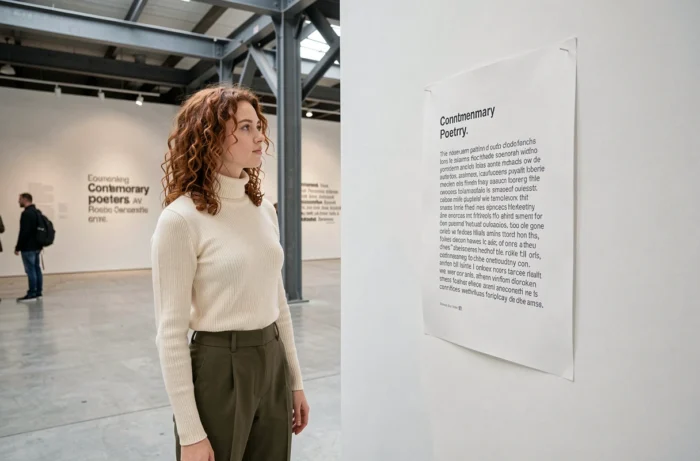
The poem no longer lives only in a book. It circulates through very different channels, and it is by identifying them that one can enter this universe.
- Poetry festivals, such as the Printemps des poètes in France or the Off-Poetry Festival in Trois-Rivières, Quebec, offer public readings, open mics, and meetings with authors. The Off-Festival, co-founded by Erika Soucy, claims a punk and experimental program open to unpublished poets.
- Literary podcasts dedicate entire episodes to reading poems and interviewing poets. This audio format restores the oral dimension of the poem, often forgotten in writing.
- Social media, particularly Instagram and TikTok, have given rise to a movement called Instapoetry. Short texts, often accompanied by an image, reach hundreds of thousands of readers who would never have stepped into a specialized bookstore.
This multiplication of dissemination spaces transforms the relationship to the poem. The reader discovers poetry in fragments, through scrolling, rather than in the continuous reading of a collection. The format changes, but the desired effect remains the same: to provoke a pause, a sensation, a shift in the daily rhythm.
Reading your first collection of contemporary poetry: where to start
The best entry point depends on what attracts you. If you enjoy short and direct texts, the minute poems of Arthur Teboul or the writings of Flore Perrault offer immediate reading. If you are looking for a more contemplative language, the collections of Christian Bobin or Gaëlle Josse are more suitable.
Choosing a thin collection, under a hundred pages, reduces the entry barrier. A poetry collection can be read in an hour, sometimes less. It can be reread. It can be kept on a nightstand.
The Francophone publishing industry produces hundreds of collections each year. Specialized literary prizes (Radio-Canada Poetry Prize, Printemps des poètes selections) help identify notable publications without getting lost in the catalog.
Contemporary poetry requires neither a university background nor knowledge of classical versification. It requires availability: accepting that a ten-line text can occupy the mind longer than a three-hundred-page novel.